Does Holding Onto the Treadmill Burn Less Calories
Yes, holding onto the treadmill handrails burns fewer calories because it reduces your core and upper body muscle activation by 10-20%. When you grip the rails, your natural arm-leg coordination and posture change, lowering workout intensity and overall energy expenditure.
Using handrails also diminishes balance challenges and stabilizer muscle engagement, making your session less efficient.
If you want to understand how posture, muscle use, and safety interplay with calorie burn, keep exploring these factors.
Key Takeaways
- Holding onto treadmill handrails reduces calorie burn by 10-20% due to lower core and stabilizing muscle engagement.
- Gripping handrails diminishes upper body muscle activation, decreasing overall workout intensity and energy expenditure.
- Proper balance and posture without handrail use maximize core muscle engagement and improve calorie burn.
- Light or brief handrail use maintains safety but excessive reliance lowers muscle activation and workout effectiveness.
- Avoiding handrails encourages natural arm-leg coordination and full-body involvement, enhancing calorie burn and workout efficiency.
Does Holding Onto the Treadmill Reduce Calorie Burn?
Although holding onto the treadmill handrails can provide stability, it greatly reduces your calorie burn by decreasing the engagement of core and stabilizing muscles.
Research demonstrates that gripping the rails diminishes overall muscle activation, leading to lower energy expenditure and reduced calorie efficiency.
Gripping treadmill rails reduces muscle activation, lowering energy use and cutting calorie burn efficiency.
When you rely on handrails, your body offloads balance and postural demands, which are critical for maximizing metabolic rate during treadmill exercise.
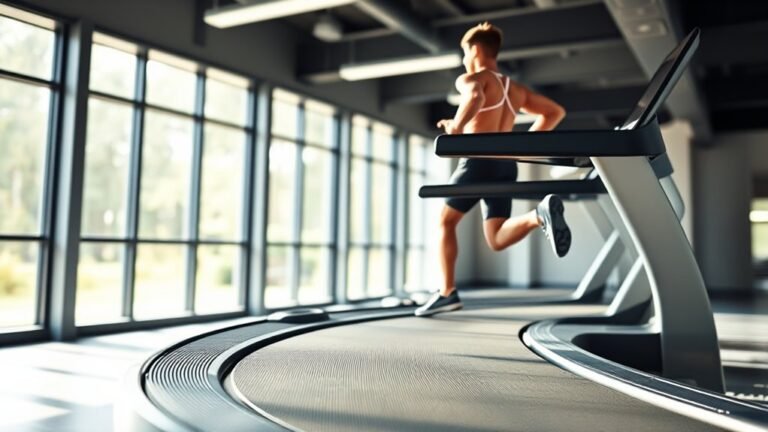
Proper treadmill technique encourages an upright posture and minimal hand support, promoting full-body muscle recruitment.
Studies measuring oxygen consumption and heart rate show a significant drop in calorie burn, up to 10-20%, when participants hold onto the treadmill.
Consequently, to optimize calorie efficiency, avoid gripping the handrails and focus on maintaining natural arm swing and core engagement during your treadmill workouts.
Why Balance and Posture Matter on the Treadmill
When you maintain proper balance and posture on the treadmill, your core muscles stay actively engaged, supporting stability and reducing injury risk.
This alignment also guarantees your walking mechanics remain natural, allowing for efficient movement patterns.
Neglecting these factors can alter muscle activation and decrease the effectiveness of your workout.
Impact On Core Engagement
Three key factors determine how effectively your core muscles engage while using a treadmill: balance, posture, and the way you hold onto the machine. Maintaining proper posture and not gripping the handrails promotes greater core stability and muscle activation.
When you rely on the treadmill for support, your core muscles work less, reducing overall engagement. Scientific studies show that free-arm treadmill walking increases activation of abdominal and lower back muscles compared to holding on.
| Factor | Effect on Core Engagement |
|---|---|
| Balance | Enhances core stability |
| Posture | Optimizes muscle activation |
| Holding Handrails | Decreases core muscle engagement |
| Free Arm Movement | Increases core muscle activation |
| Support Reliance | Reduces core stability and muscle activation |
Focus on balance and posture to maximize your core workout.
Effects On Walking Mechanics
Maintaining proper balance and posture directly influences your walking mechanics on the treadmill by promoting efficient gait patterns and reducing compensatory movements.
When you hold onto the treadmill, you disrupt natural arm swing and weight distribution, which impairs walking efficiency.
Research shows that treadmill design encourages a natural stride when you maintain an upright posture without support, optimizing muscle activation and joint alignment.
By avoiding grip, you engage stabilizing muscles that contribute to balance, improving neuromuscular control.
This enhanced coordination reduces the risk of altered biomechanics that can lead to inefficient movement patterns.
Consequently, focusing on posture and balance not only aligns your body properly but also maximizes the treadmill’s intended walking mechanics, ultimately supporting better exercise outcomes and calorie expenditure.
How Gripping the Handrails Changes Muscle Use
When you grip the treadmill handrails, you reduce the engagement of your upper body muscles, which can decrease overall workout intensity.
This altered posture may also affect your natural gait and balance, limiting muscle activation in your core and lower limbs.
Consequently, holding on can lower the number of calories you burn compared to walking without support.
Reduced Upper Body Engagement
Gripping the handrails during treadmill exercise greatly reduces the activation of upper body muscles, altering overall muscle engagement. When you hold onto the treadmill grip, your arms and shoulders become less involved, decreasing the recruitment of muscles like the deltoids, biceps, and triceps.
Research using electromyography (EMG) shows a significant drop in upper body muscle activation compared to when you swing your arms freely. This reduced engagement means your body relies more on lower body muscles, potentially lowering total energy expenditure.
You also limit the natural arm-leg coordination that contributes to efficient movement and calorie burn. Consequently, by gripping the handrails, you diminish upper body involvement, which can affect workout intensity and overall calorie output, underscoring the importance of minimizing treadmill grip to maximize muscle use.
Altered Posture Effects
Although holding the treadmill handrails may provide stability, it alters your natural posture, affecting muscle recruitment patterns throughout your body.
Gripping the handrails often causes you to lean forward or hunch, disrupting ideal posture alignment. This shift decreases activation in core and lower limb muscles, which are essential for balance and propulsion during walking or running.
While treadmill safety is important, over-reliance on handrails can reduce proprioceptive feedback and challenge your balance less, potentially diminishing neuromuscular engagement.
Research indicates that maintaining a neutral posture without gripping promotes more effective muscle use and joint alignment.
As a result, to maximize muscular activation while preserving treadmill safety, it’s advisable to use handrails only when necessary and focus on keeping your posture aligned naturally throughout your workout.
Impact on Calorie Burn
Altering your posture by holding the treadmill handrails directly influences how your muscles engage, which in turn affects calorie expenditure. When you grip the rails, your upper body stabilizes more passively, reducing activation in core and arm muscles.
This shift decreases overall workout efficiency and lowers calorie burn compared to free-arm walking or running.
| Muscle Group | Holding Handrails | No Handrail Support |
|---|---|---|
| Core | Reduced activation | Increased activation |
| Arm Muscles | Minimal engagement | Active engagement |
| Leg Muscles | Full engagement | Full engagement |
How Holding Onto Handrails Affects Workout Intensity
Research shows that holding onto handrails during treadmill exercise can reduce your workout intensity by decreasing the engagement of stabilizing muscles and lowering overall energy expenditure.
When you rely on a handrail grip, your body offloads some balance and support responsibilities, which diminishes muscle activation in your core and lower limbs.
This reduction in muscular effort directly impacts workout efficiency, as your cardiovascular system works less strenuously, leading to fewer calories burned.
Studies measuring oxygen consumption and heart rate confirm that grip assistance lowers exercise intensity compared to free-arm movement.
Consequently, while holding onto handrails might feel safer or more stable, it compromises the biomechanical and metabolic demands of your workout, ultimately reducing its effectiveness for calorie burning and fitness improvement.
Who Should Hold Onto the Treadmill and When
When might you need to hold onto the treadmill during your workout? You should consider it if you’re new to treadmill exercise, recovering from injury, or working on balance issues. Holding on can enhance treadmill safety by providing stability and preventing falls.
However, it’s vital to use a proper grip—lightly resting your hands rather than gripping tightly—to avoid reducing workout intensity. If you feel unsteady at higher speeds or inclines, holding on briefly can help maintain control without compromising form.
Conversely, if you have good balance and experience, avoid relying on the handrails to guarantee you engage your core and muscles effectively.
Always prioritize treadmill safety, but balance it with maintaining workout quality through appropriate grip and handrail use.
Tips to Burn More Calories Safely on the Treadmill
If you want to maximize calorie burn on the treadmill without increasing injury risk, focus on incorporating interval training and adjusting incline strategically. Research shows treadmill intervals boost metabolism and calorie expenditure more effectively than steady-state walking.
Maximize treadmill calorie burn safely with interval training and strategic incline adjustments.
Similarly, modifying incline settings increases muscle engagement and energy cost, enhancing overall calorie burn.
To safely enhance your treadmill workout, consider these tips:
- Alternate high-intensity bursts with recovery periods using treadmill intervals.
- Gradually increase incline settings to challenge muscles without overstraining.
- Maintain proper posture and avoid holding onto handrails to engage core and stabilize muscles.
- Monitor heart rate to guarantee you stay within a safe exertion zone during intervals and incline changes.
These evidence-based strategies promote efficient calorie burning while minimizing injury risk.
Better Ways to Maintain Balance Without Holding Handrails
Maximizing calorie burn on the treadmill involves maintaining proper posture and avoiding holding onto handrails, which can reduce muscle engagement. To maintain balance without support, incorporate balance exercises and core strengthening into your routine.
Strengthening your core enhances stability by improving neuromuscular control, reducing reliance on handrails. Try planks, bird-dogs, or single-leg stands to activate key stabilizing muscles.
Additionally, practicing dynamic balance exercises like heel-to-toe walking improves proprioception, allowing better control during treadmill workouts. When walking or running, engage your abdominal and lower back muscles consciously to sustain an upright posture.
Over time, these strategies will help you maintain balance naturally, increase muscle activation, and ultimately boost calorie expenditure. Avoiding handrails encourages full-body involvement, making your treadmill sessions more effective and efficient.
Frequently Asked Questions
Can Holding Onto the Treadmill Cause Wrist or Hand Injuries?
Yes, holding onto the treadmill can cause wrist strain due to prolonged pressure and compromised grip strength. This repetitive stress may lead to discomfort or injury.
Does Treadmill Handrail Use Affect Heart Rate Monitoring Accuracy?
Yes, using the treadmill handrail can affect heart rate accuracy by altering your natural movement and grip, which may interfere with sensor readings. For precise heart rate accuracy, minimize handrail impact and maintain natural arm swing.
Are There Specific Treadmill Models Designed for Safe Handrail Use?
Like a well-crafted ship, some treadmill designs prioritize user safety with ergonomically placed handrails and stability features. These models reduce fall risk while allowing safe handrail use, supported by biomechanical studies confirming improved balance and control.
How Does Treadmill Incline Impact Calorie Burn With or Without Handrails?
You’ll increase calorie expenditure considerably by raising the treadmill incline, as it intensifies muscle engagement and cardiovascular demand. Using handrails may slightly reduce this effect by lessening balance effort, but incline remains the primary factor.
Can Holding Handrails Help Beginners Avoid Falls on the Treadmill?
Yes, holding handrails enhances treadmill safety by providing stability, especially for beginners. Research supports this as a key beginner tip to prevent falls, allowing you to build confidence and maintain balance while mastering treadmill use.
Conclusion
Holding onto the treadmill handrails is like leaning on training wheels—it offers stability but reduces your workout’s effectiveness by limiting muscle engagement and calorie burn. When you grip the rails, your body doesn’t have to work as hard to maintain balance, which lowers the intensity of your exercise.
To maximize results, focus on maintaining proper posture and balance without holding onto the rails. This approach ensures your muscles are fully engaged, increasing your workout intensity and energy expenditure.
Use the handrails only when necessary for safety. Then, gradually challenge yourself to improve your balance and boost calorie burn through better mechanics and controlled movement. In conclusion, holding onto the treadmill burns fewer calories compared to running or walking without support.