What to Look for in a Treadmill
When choosing a treadmill, look for a powerful motor—at least 3.0 CHP if you plan to run—and precise speed and incline adjustments to match your fitness goals. Confirm the running surface is long and wide enough (60+ inches by 20 inches), with quality cushioning for shock absorption and joint protection.
Built-in workout programs and smart tracking features enhance training effectiveness. Also, consider your available space and budget, plus maintenance needs. Explore further to optimize comfort and performance.
Key Takeaways
- Choose a treadmill with appropriate motor power: at least 2.0 CHP for walking, 3.0 CHP or higher for running.
- Ensure the running surface is spacious (minimum 55 inches length for walking, 60+ inches for running) with quality cushioning for shock absorption.
- Look for adjustable speed and incline settings with responsive controls to customize workout intensity.
- Consider built-in workout programs and smart features like fitness tracking and app connectivity for enhanced training.
- Measure your available space and select a treadmill that fits, preferably foldable if space is limited, balancing features within your budget.
How to Choose the Right Treadmill for Your Fitness Goals
How do you select a treadmill that aligns perfectly with your fitness goals?
First, identify the treadmill types that suit your workout intensity. If you’re focused on running, opt for motorized treadmills with powerful motors and shock absorption. For walking or light jogging, manual treadmills might suffice.
Next, consider treadmills with integrated fitness trackers; these advanced systems monitor heart rate, calories burned, and pace in real-time. They provide actionable data to optimize your training sessions.
Additionally, look for customizable workout programs tailored to endurance, weight loss, or interval training.
Prioritize treadmills offering precise speed and incline adjustments to match your progression.
Finding a Treadmill That Fits Your Space and Budget
Where you place your treadmill and how much you invest are critical factors in your selection process. Addressing space considerations upfront helps you choose a model that fits comfortably without overcrowding.
Simultaneously, budget constraints guide you toward options that deliver value without overspending.
To optimize your decision, focus on these key points:
- Measure available floor space carefully, accounting for treadmill dimensions and user clearance.
- Consider foldable or compact designs if space is limited.
- Set a realistic budget that balances features with affordability.
- Research warranties and maintenance costs to avoid hidden expenses.
Motor Power and Speed Settings on Your Treadmill
Once you’ve identified a treadmill that fits your space and budget, evaluating its motor power and speed settings becomes a priority. The treadmill horsepower directly impacts how smoothly the belt runs and how well it handles different workout intensities.
Choosing a treadmill means prioritizing motor power and speed settings for smooth, effective workouts.
For walking, a motor with at least 2.0 continuous horsepower (CHP) suffices, but for running, aim for 3.0 CHP or higher to guarantee durability and performance. Speed settings typically range from 0.5 to 12 mph; choose a treadmill that matches your fitness goals, whether walking, jogging, or sprinting.
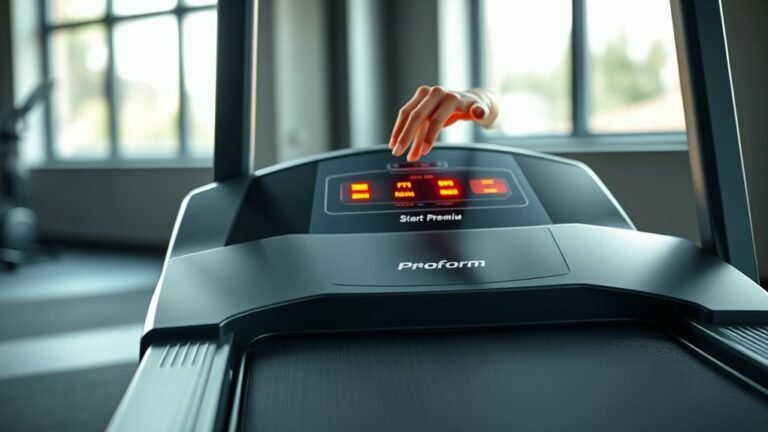
Additionally, an adjustable incline feature enhances workout variety and intensity by simulating uphill terrain. Confirm that both speed and incline controls are responsive and easy to adjust mid-workout.
Prioritizing motor power and speed guarantees your treadmill delivers a reliable, customizable exercise experience.
Running Surface Size and Cushioning for Comfort and Safety
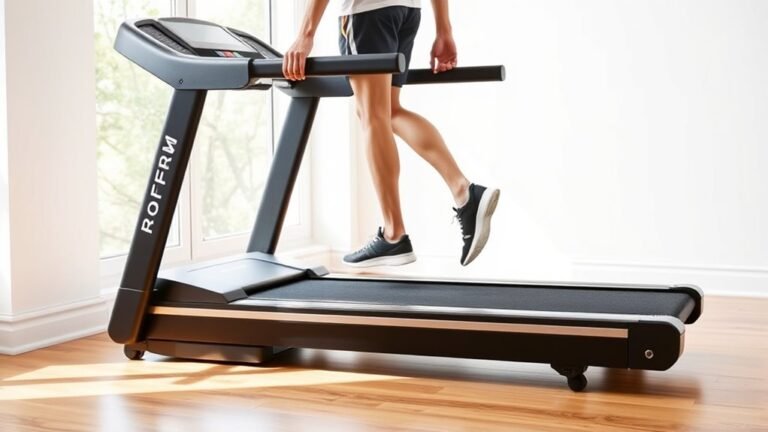
A treadmill’s running surface size and cushioning greatly influence your comfort and safety during workouts. Choosing the right treadmill size guarantees you have enough room for natural stride length and reduces the risk of missteps.
Cushioning options absorb impact, protecting your joints and enhancing endurance.
Consider these factors when evaluating running surface and cushioning:
- Length and width: Aim for at least 55 inches long and 20 inches wide for walking; runners may need 60+ inches in length.
- Shock absorption materials: Look for multi-layered belts with elastomer or gel inserts to reduce impact.
- Adjustable cushioning: Some treadmills let you tailor firmness based on your preference and workout type.
- Durability: High-quality cushioning maintains performance over time without compressing or degrading.
Prioritize treadmill size and cushioning options to maximize workout safety and comfort.
Key Built-In Workout Programs and Smart Features to Look For
You’ll want to evaluate treadmills that offer a variety of built-in workout programs like interval training, hill climbs, and heart rate control to tailor your sessions effectively.
Look for smart features such as touchscreen displays, Bluetooth connectivity, and app integration that enhance user experience and data tracking.
These technologies can optimize your training by providing real-time feedback and personalized adjustments.
Popular Workout Program Types
Several key workout program types can greatly enhance your treadmill experience by offering structured training tailored to various fitness goals.
Look for treadmills that incorporate interval training programs, which alternate between high-intensity bursts and recovery periods to efficiently boost cardiovascular fitness.
Strength workouts integrated into treadmill routines often involve incline variations to engage different muscle groups.
Other popular built-in programs include:
Hill Climb: Simulates varied inclines, enhancing leg strength and endurance.
Fat Burn: Maintains a steady pace ideal for burning calories.
Cardio: Focuses on sustained moderate to high intensity for heart health.
Custom Workouts: Allows you to tailor speed and incline profiles based on personal goals.
Selecting a treadmill with diverse, well-designed programs guarantees you stay motivated and progress effectively.
Innovative Smart Treadmill Features
How do smart treadmill features elevate your workout beyond traditional programs? By integrating smart connectivity, these treadmills sync with your smartphone or fitness apps, delivering real-time data and personalized workout adjustments.
Built-in workout programs now adapt based on your heart rate and performance metrics, optimizing intensity without manual input. Advanced fitness tracking monitors parameters such as calorie burn, cadence, and VO2 max estimates, providing thorough insights.
Some models offer virtual coaching and interactive courses that simulate outdoor terrains or group classes, enhancing engagement. Additionally, features like automatic incline and speed adjustments respond dynamically to your biometric feedback, ensuring efficient progression.
When choosing a treadmill, prioritize these innovative smart features to maximize workout effectiveness and maintain motivation through precise performance monitoring and seamless device integration.
Simple Maintenance Tips to Keep Your Treadmill Running Smoothly
To keep your treadmill operating efficiently, you should regularly lubricate the belt to reduce friction and wear.
Make sure to clean dust and debris from the motor housing and deck to prevent overheating and mechanical issues.
Additionally, inspect and tighten all bolts periodically to maintain structural stability and safety.
Regular Belt Lubrication
Regular lubrication plays an essential role in maintaining your treadmill’s belt and deck, preventing excessive friction that can lead to premature wear and motor strain.
Proper belt maintenance guarantees smooth operation and extends the equipment’s lifespan.
You should follow the manufacturer’s recommended lubrication frequency, typically every three to six months depending on usage.
When lubricating, focus on these key steps:
- Use a silicone-based lubricant specifically designed for treadmills.
- Lift the belt gently and apply lubricant evenly along the deck’s underside.
- Avoid over-lubricating, which can cause slipping or residue buildup.
- Run the treadmill at a slow speed for a few minutes post-application to distribute the lubricant uniformly.
Adhering to these practices keeps your treadmill running efficiently and reduces costly repairs.
Clean Dust and Debris
Although you mightn’t notice it immediately, dust and debris can accumulate inside your treadmill’s motor housing and belt area, causing decreased performance and potential mechanical issues.
Effective treadmill cleaning involves regular dust removal to prevent overheating and friction.
Begin by unplugging the machine, then use a vacuum with a narrow nozzle to extract dust from vents and motor compartments.
Wipe down the belt and surrounding surfaces with a damp cloth to eliminate dirt particles that could impair belt movement.
Avoid using harsh chemicals that might damage components.
Consistent dust removal minimizes wear on the motor and belt, ensuring smoother operation and extending your treadmill’s lifespan.
Incorporate this simple maintenance step into your routine to keep your treadmill running efficiently and avoid costly repairs.
Inspect and Tighten Bolts
A secure treadmill depends heavily on properly tightened bolts throughout its frame and motor housing. During your routine safety checks, focus on these critical points to guarantee stability and prevent mechanical issues.
After initial treadmill assembly, bolts can loosen over time due to vibration and use.
Check and tighten bolts located at:
- The base frame connections to maintain structural integrity
- Motor housing to prevent misalignment or damage
- Console mounting points guaranteeing user interface stability
- Deck support brackets to avoid belt misalignment or excessive wear
Use a torque wrench or appropriate tools to tighten bolts to manufacturer specifications.
Consistently inspecting and securing these fasteners enhances performance and extends your treadmill’s lifespan while safeguarding your workout environment.
Frequently Asked Questions
Can I Use a Treadmill Outdoors or Only Indoors?
You can use a treadmill outdoors only if it has specific outdoor compatibility features. Most models lack treadmill durability against weather elements, so using an indoor treadmill outside risks damage and voids warranties. Choose accordingly.
How Noisy Are Treadmills During Operation?
Treadmills hum like a gentle river, but noise levels vary widely. You’ll want one with quality sound insulation to minimize disruption.
Look for models specifying decibel ratings and cushioned decks that reduce mechanical clatter during operation.
What Warranty Is Typical for Treadmill Parts?
You’ll typically find treadmill warranty coverage ranging from 1 to 5 years for parts. This protects your investment by ensuring parts longevity, covering components like the motor, belt, and frame against defects or premature wear.
Are Treadmills Suitable for Elderly Users?
Think of a treadmill as a steady river. If you prioritize senior safety and user comfort, it can be suitable for elderly users by featuring low step-up heights, secure handrails, and cushioned decks to reduce joint impact effectively.
Can I Connect My Treadmill to Fitness Apps?
Yes, you can connect your treadmill to fitness apps if it supports Bluetooth or Wi-Fi. Check the app compatibility and verify the treadmill offers fitness tracking features like heart rate monitoring and workout syncing for seamless integration.
Conclusion
When choosing your treadmill, focus on matching motor power to your workout intensity. Select a running surface that offers both comfort and safety. Explore built-in programs that keep you motivated throughout your exercise routine.
Prioritize space and budget without sacrificing essential features. Maintain your machine regularly to guarantee longevity and smooth performance.
By balancing these elements thoughtfully, you’ll invest in a treadmill that supports your fitness goals, fits your lifestyle, and delivers reliable results every step of the way. Remember, knowing what to look for in a treadmill is key to making the best choice for your needs.