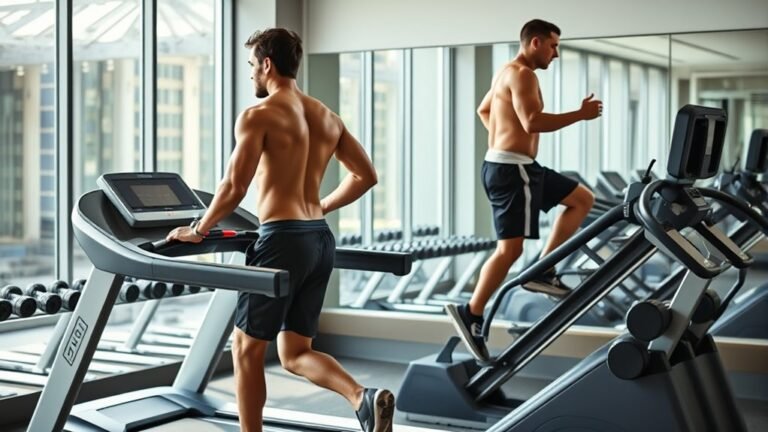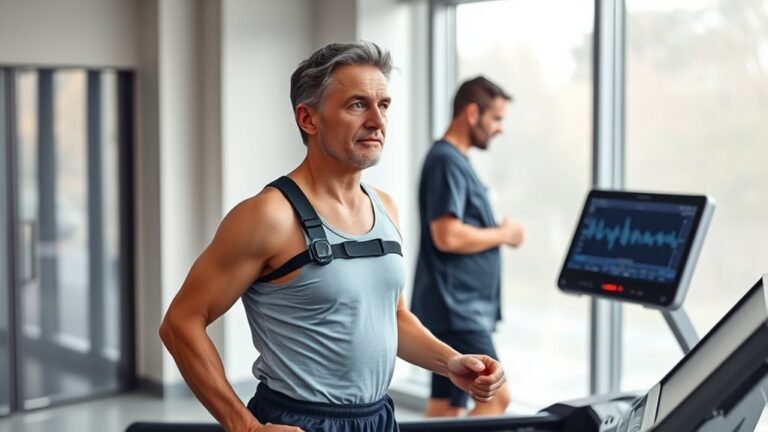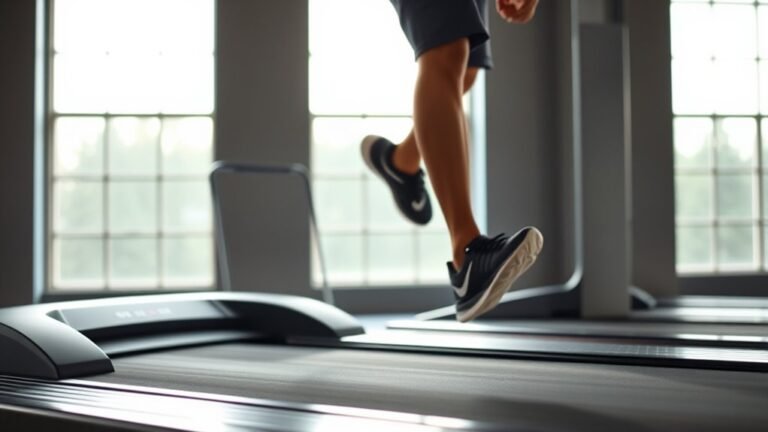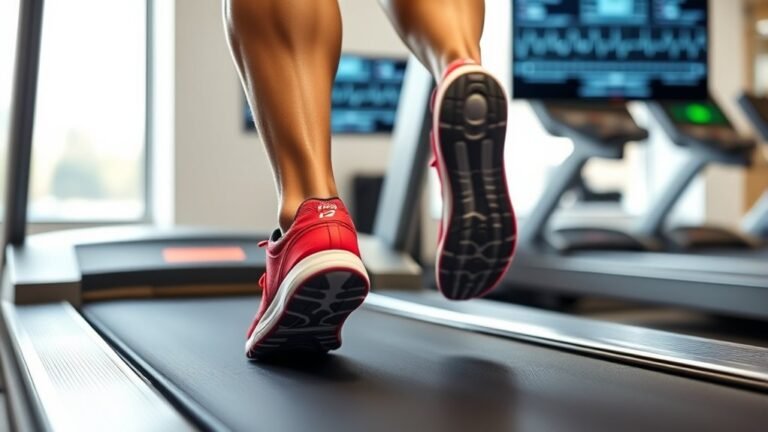
What’s the Benefit of a Curved Treadmill
A curved treadmill offers numerous benefits by giving you precise control over your stride and cadence, relying solely on your effort to move the belt. This unique design encourages a natural midfoot or forefoot strike, which improves running form and efficiency.
It also engages more muscle groups such as the glutes and hamstrings, providing a more intense, calorie-burning workout. Additionally, it reduces joint impact and lowers the risk of injury.
Another advantage is that it operates without electricity, making it eco-friendly and low maintenance. You can explore how it enhances both performance and sustainability further.
Key Takeaways
- Curved treadmills promote natural running form by encouraging midfoot strikes and upright posture, enhancing biomechanics and reducing impact injuries.
- They increase workout intensity and calorie burn by requiring users to self-propel the belt, engaging more muscles and boosting cardiovascular efficiency.
- These treadmills improve running efficiency with dynamic foot strike response, minimizing ground contact time and optimizing energy use during runs.
- They activate multiple muscle groups, including core and posterior chain, improving balance, coordination, and lowering injury risks like shin splints.
- Curved treadmills are energy-efficient, using no electricity, reducing carbon footprint, and requiring less maintenance for longer equipment lifespan.
What Is a Curved Treadmill and How Does It Work?
A curved treadmill is a non-motorized running machine designed with a concave running surface that responds directly to your foot strike and pace. This design enables the belt to move solely through your own effort, unlike motorized treadmills.
As you run, the curve naturally propels the belt backward, requiring precise control of your stride and cadence. The curved treadmill benefits include enhanced muscle engagement and improved running biomechanics, as you must actively drive the belt rather than passively following a set speed.
This direct feedback loop positively influences the user experience by promoting a more natural, efficient running form and reducing impact forces.
Understanding its mechanics helps you appreciate how this advanced equipment optimizes training outcomes through biomechanical responsiveness and metabolic demand.
How Self-Powered Curved Treadmills Increase Workout Intensity
You engage your natural running mechanics on a self-powered curved treadmill, which responds directly to your pace and effort.
This variable speed control forces you to maintain consistent power output, increasing workout intensity without preset settings.
As a result, your calorie burn enhances considerably compared to traditional treadmills.
Natural Running Mechanics
Three key factors distinguish self-powered curved treadmills in replicating natural running mechanics: belt curvature, user-driven propulsion, and responsive feedback.
The curved belt aligns with your foot strike arc, promoting natural biomechanics by encouraging a midfoot landing and reducing impact forces. This design compels you to maintain an ideal running posture, preventing slouching and excessive forward lean, which often occur on flat treadmills.
Because you power the belt with each stride, you engage stabilizing muscles more effectively, mirroring outdoor running demands.
Responsive feedback from the treadmill dynamically adjusts to your exertion, enabling you to sustain consistent cadence and stride length without external controls.
Together, these features enhance your proprioception and running economy, providing a workout that closely mimics natural terrain and mechanics, ultimately improving performance and reducing injury risk.
Variable Speed Control
Building on how curved treadmills replicate natural running mechanics, the self-powered design inherently grants variable speed control through your own effort. Unlike motorized models, the treadmill belt moves only when you push it, enabling immediate and seamless speed adjustments.
This direct correlation between your stride and belt speed maximizes user control, allowing you to intuitively regulate pace without delay or preset settings. As you accelerate, the curved surface facilitates smooth shifts, maintaining momentum efficiently.
This dynamic responsiveness challenges your neuromuscular system more effectively, increasing workout intensity.
Fundamentally, the self-powered curved treadmill empowers you to fine-tune your speed in real time, fostering a more engaging and adaptive training session that aligns perfectly with your natural running rhythm and performance goals.
Enhanced Calorie Burn
The self-powered mechanism of curved treadmills greatly amplifies workout intensity by demanding continuous effort to propel the belt forward. This mechanical engagement considerably increases your caloric expenditure compared to motorized treadmills, as you control speed and stride dynamically.
The increased muscular activation provides a substantial metabolic boost, enhancing fat oxidation and cardiovascular efficiency simultaneously.
| Feature | Motorized Treadmill | Curved Treadmill |
|---|---|---|
| Caloric Expenditure | Moderate | High |
| Muscle Engagement | Low to Moderate | High |
| Metabolic Boost | Limited | Considerable |
Using a curved treadmill optimizes your workout by integrating higher energy demand, ensuring you burn more calories in less time with improved metabolic response.
How Curved Treadmills Boost Running Efficiency
You’ll find that curved treadmills promote natural running mechanics by encouraging a midfoot strike and proper stride alignment.
This design forces you to engage stabilizing muscles more effectively, enhancing overall muscle activation.
As a result, your running efficiency improves through optimized biomechanics and increased muscular coordination.
Natural Running Mechanics
Although traditional treadmills impose a fixed belt speed, curved treadmills respond directly to your foot strike and stride, promoting a more natural running form.
This design aligns closely with your intrinsic running biomechanics, allowing your body to maintain an authentic natural gait.
When you run on a curved treadmill, the belt speed adjusts dynamically to your propulsion, enabling you to engage in a self-paced, biomechanically efficient motion.
This interaction reduces the mechanical constraints typical of motorized treadmills, facilitating proper foot placement and stride length.
Consequently, you experience improved joint alignment and reduced impact forces, which can enhance running economy.
Enhanced Muscle Engagement
By running on a curved treadmill, you actively engage a broader range of muscles compared to traditional flat treadmills. The curved design demands increased muscle activation in your calves, hamstrings, glutes, and core to propel your body forward efficiently.
Unlike motorized treadmills, you control the belt speed with your effort, which recruits stabilizing muscles that are often underutilized. This heightened muscle engagement promotes balanced strength development, improving your running economy and reducing injury risk.
Additionally, the biomechanical demands of the curved surface encourage a more natural foot strike and stride, further enhancing muscular coordination.
How Curved Treadmills Engage More Muscle Groups
Engaging a curved treadmill activates a broader range of muscle groups compared to traditional flat models. When you run on a curved surface, your body must continuously adjust to the natural arc, which increases muscle activation in your hamstrings, glutes, and calves.
Unlike motorized treadmills, the curved design requires you to propel the belt with your own force, demanding greater leg drive and stability.
Additionally, the non-motorized mechanism enhances core engagement, as your abdominal and lower back muscles work harder to maintain balance and posture.
This extensive muscle recruitment improves functional strength and coordination.
Curved Treadmills for High-Intensity Interval Training
The increased muscle activation and self-propelled mechanics of curved treadmills make them particularly effective for high-intensity interval training (HIIT).
When you engage in curved treadmill workouts, you actively control speed and intensity without relying on motorized assistance, enhancing neuromuscular coordination.
This dynamic control optimizes interval training benefits by allowing precise modulation of effort during sprints and recovery phases, maximizing cardiovascular and metabolic responses.
Additionally, the curved surface demands consistent propulsion from your posterior chain muscles, increasing power output during high-intensity bouts. This results in improved anaerobic capacity and muscular endurance.
Using a curved treadmill for HIIT also reduces impact forces compared to traditional treadmills, minimizing injury risk during explosive intervals.
Incorporating curved treadmill workouts into your routine consequently offers a technically superior platform to elevate your interval training benefits effectively.
How Curved Treadmills Improve Running Form
Although running form can be challenging to perfect on flat, motorized treadmills, curved treadmills compel you to adopt a more efficient gait pattern. The curved design demands precise treadmill alignment with your foot strikes, promoting a natural midfoot or forefoot landing.
Curved treadmills encourage precise foot placement, naturally fostering a more efficient midfoot or forefoot running gait.
This alignment encourages ideal running posture by reducing overstriding and encouraging an upright torso. As you propel yourself forward, the curved surface requires active engagement of your core and leg muscles, reinforcing proper biomechanics.
Unlike motorized treadmills that can mask form flaws, curved treadmills provide immediate feedback through your movement, allowing you to self-correct.
Over time, this fosters a running form that maximizes energy efficiency, reduces ground contact time, and enhances stride cadence, making your running posture more biomechanically sound and effective.
How Curved Treadmills Help Prevent Injuries
Because curved treadmills require you to actively drive each stride, they reduce the risk of repetitive impact injuries often caused by improper foot strike patterns. This design offers significant biomechanical benefits that contribute to injury prevention by promoting natural running mechanics.
When you run on a curved treadmill, you:
- Engage your posterior chain more effectively, balancing muscle activation.
- Minimize heel striking, reducing joint stress and impact forces.
- Enhance proprioception, improving coordination and stability.
- Self-regulate speed and effort, preventing overexertion.
These factors collectively lower the likelihood of injuries like shin splints, plantar fasciitis, and knee pain.
How Curved Treadmills Save Energy and Lower Your Carbon Footprint
In addition to promoting safer running mechanics, curved treadmills offer energy-saving advantages that directly impact your environmental footprint.
Unlike traditional motorized treadmills, curved models operate purely on your kinetic energy, eliminating electricity consumption.
This design enables substantial energy conservation, reducing reliance on grid power and lowering greenhouse gas emissions associated with energy production.
By choosing a curved treadmill, you embrace eco-friendly fitness practices that align with sustainable living goals.
Choosing a curved treadmill supports eco-friendly workouts and advances your commitment to sustainable living.
The absence of a motor also minimizes maintenance and extends equipment lifespan, further decreasing environmental impact.
Integrating a curved treadmill into your routine allows you to exercise effectively while actively reducing your carbon footprint, making it a responsible choice for both health and the planet.
This technology sets a new standard in sustainable fitness equipment.
Frequently Asked Questions
Are Curved Treadmills Suitable for Beginners or Only Advanced Runners?
Curved treadmills suit beginner runners if you adjust training methods gradually. They enhance form and build strength but demand controlled pacing.
Start slow, focus on technique, and progressively increase intensity for safe, effective workouts.
How Much Do Curved Treadmills Typically Cost Compared to Traditional Ones?
Curved treadmills typically cost considerably more than traditional ones, often double or triple the price. You’ll need to weigh price comparison and budget considerations carefully before investing, as they’re designed for specialized training benefits.
Can Curved Treadmills Be Used Safely by People With Joint Problems?
You can use curved treadmills safely with joint problems because their design promotes natural stride and reduces impact forces. This enhances joint safety and supports injury prevention through self-paced, low-impact exercise controlled by your own effort.
What Maintenance Is Required to Keep a Curved Treadmill in Good Condition?
You should follow maintenance tips like weekly cleaning frequency of the belt and frame, monthly lubrication, and inspecting bolts.
Regularly removing dust and sweat buildup guarantees peak performance and extends your curved treadmill’s lifespan effectively.
Do Curved Treadmills Require Special Shoes or Equipment?
You don’t need special shoes for curved treadmills; standard running shoe types with good grip and cushioning work best.
Equipment requirements focus on proper footwear to enhance performance and prevent injury during your dynamic, self-powered workout.
Conclusion
Stepping onto a curved treadmill is like harnessing the power of your own momentum, turning every stride into a precision-engineered workout. You’ll engage more muscles, boost efficiency, and refine your running form while reducing injury risk. This self-powered marvel not only intensifies your training but also trims energy waste, making your fitness journey both effective and eco-conscious.
Embrace the curve, and transform your run into a seamless blend of science and strength. The benefit of a curved treadmill lies in its ability to deliver a more natural, challenging, and rewarding exercise experience.