What Does a Treadmill Stress Test Show
A treadmill stress test shows how your heart performs under exercise stress by monitoring heart rate, blood pressure, and ECG changes. It reveals your heart’s ability to increase output, detect abnormal rhythms, and identify signs of ischemia or blocked arteries.
The test also evaluates recovery time to assess cardiac efficiency and autonomic function. These insights help doctors diagnose cardiovascular conditions and tailor treatment. Understanding these details provides a deeper picture of your heart health and risks.
Key Takeaways
- A treadmill stress test shows how the heart responds to physical exertion by monitoring heart rate, blood pressure, and ECG changes during exercise.
- It detects abnormalities like arrhythmias, ischemia, and conduction blocks that may not be evident when the heart is at rest.
- The test reveals whether blood flow to the heart muscle is adequate under stress, indicating potential coronary artery disease.
- Heart rate and blood pressure responses help evaluate cardiovascular health and the heart’s ability to handle increased workload safely.
- Recovery time post-exercise provides insight into heart efficiency and autonomic nervous system function, aiding in risk assessment and treatment planning.
What Is a Treadmill Stress Test?
A treadmill stress test evaluates how your heart responds to physical exertion by monitoring its function while you walk or run on a treadmill.
To prepare for the test, you should follow specific test preparation tips: avoid caffeine, tobacco, and heavy meals several hours prior, wear comfortable clothing and shoes, and inform your healthcare provider about medications you’re taking.
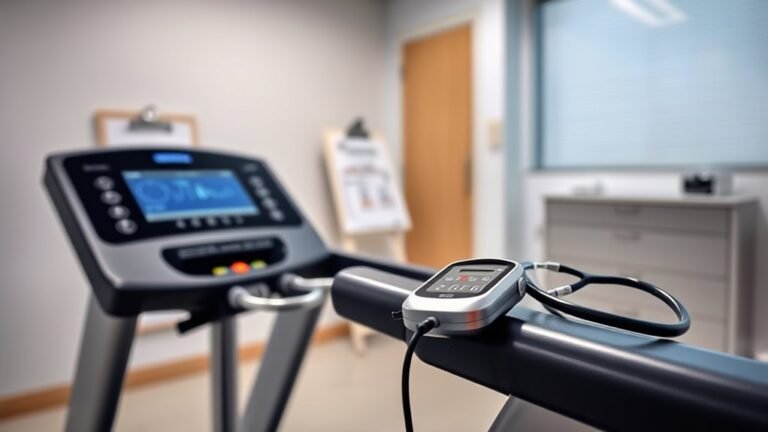
The test procedure overview begins with attaching electrodes to your chest to record your heart’s electrical activity.
As you walk or run on the treadmill, the speed and incline gradually increase to raise your heart rate.
Throughout the test, medical staff continuously monitor your essential signs and watch for any abnormal heart rhythms or symptoms.
This structured approach guarantees accurate assessment of your cardiovascular response under stress.
Measuring Heart Function During a Treadmill Stress Test
Although you might focus on the physical exercise during a treadmill stress test, the primary goal lies in accurately measuring your heart’s function under increasing workload.
As exercise intensity escalates incrementally, clinicians monitor parameters like cardiac output, ventricular response, and blood pressure.
The test duration provides a controlled timeline to observe how efficiently your heart adapts to stress, revealing potential ischemic changes or functional limitations.
Continuous electrocardiographic and hemodynamic assessments capture real-time data on myocardial performance, enabling precise evaluation of cardiac reserve.
Real-time ECG and hemodynamic monitoring provide detailed insights into myocardial function and cardiac reserve during stress testing.
By correlating these measurements with exercise intensity and test duration, healthcare providers can identify abnormalities in heart function that may not be evident at rest.
This systematic approach guarantees a thorough analysis of your heart’s capacity to handle physical stress.
Heart Rate Changes During a Treadmill Stress Test
You’ll observe that a normal heart rate response during a treadmill stress test includes a predictable increase proportional to exercise intensity.
Any deviations from this pattern, such as chronotropic incompetence or exaggerated tachycardia, indicate abnormal heart rate behavior.
Understanding these variations helps you assess cardiac function and potential underlying conditions.
Normal Heart Rate Response
When undergoing a treadmill stress test, your heart rate should increase progressively in response to escalating exercise intensity, reflecting normal cardiac function.
This rise indicates your heart’s ability to meet the metabolic demands of your muscles, correlating with your aerobic capacity.
Additionally, heart rate variability (HRV) typically decreases as exercise intensity rises, demonstrating autonomic nervous system modulation.
Key indicators of a normal heart rate response include:
- Gradual increase in beats per minute aligned with workload increments
- Achievement of target heart rate based on age and fitness level
- Controlled reduction in heart rate during recovery phase
Monitoring these parameters helps assess your cardiovascular health and aerobic efficiency during the stress test.
Abnormal Heart Rate Patterns
If your heart rate deviates from expected patterns during a treadmill stress test, it may indicate underlying cardiac abnormalities or autonomic dysfunction. Abnormal rhythms, such as arrhythmias or inappropriate heart rate recovery, can signal impaired cardiac response to exercise, affecting your prognosis and exercise implications.
| Abnormal Heart Rate Pattern | Clinical Significance |
|---|---|
| Chronotropic Incompetence | Inadequate heart rate increase |
| Exercise-Induced Arrhythmia | Risk of ischemia or structural issues |
| Excessive Tachycardia | Autonomic imbalance or ischemia |
| Blunted Heart Rate Recovery | Autonomic dysfunction, poor prognosis |
| Bradycardia During Exercise | Conduction system disease |
Recognizing these patterns helps tailor your treatment and exercise recommendations precisely.
Monitoring Blood Pressure and Its Importance During the Test
Although the treadmill stress test primarily evaluates cardiac function under exertion, monitoring your blood pressure throughout the procedure provides critical insights into cardiovascular response and overall hemodynamic stability.
Blood pressure readings during the test help identify abnormal vascular reactions that could indicate underlying pathology.
The test significance hinges on detecting exaggerated increases or drops in blood pressure, which may signal compromised cardiac output or autonomic dysfunction.
By tracking blood pressure, clinicians can:
- Assess your heart’s ability to maintain adequate perfusion under stress
- Detect hypertensive or hypotensive responses indicating risk factors
- Guide clinical decisions regarding exercise tolerance and medication adjustments
Thus, continuous blood pressure monitoring enhances the treadmill stress test’s diagnostic value, ensuring a thorough evaluation of your cardiovascular health beyond heart rate and rhythm analysis.
Understanding ECG Patterns in Treadmill Stress Testing
Since the ECG patterns recorded during a treadmill stress test provide direct information about your heart’s electrical activity under exertion, understanding these patterns is essential for accurate diagnosis.
During the test, continuous ECG interpretation focuses on detecting deviations in heart rhythm, including arrhythmias or conduction blocks.
Continuous ECG monitoring during the test detects arrhythmias and conduction blocks for accurate heart rhythm assessment.
You’ll notice changes in waveforms, such as P waves, QRS complexes, and ST segments, that reflect myocardial response to increased workload. Precise analysis of these alterations helps clinicians identify abnormal electrical conduction or ischemic responses.
Monitoring heart rhythm variability under stress allows evaluation of autonomic regulation and potential electrophysiological abnormalities.
How the Test Detects Coronary Artery Disease
When you undergo a treadmill stress test, it detects coronary artery disease by identifying areas where blood flow is restricted due to blocked arteries.
The test continuously monitors your heart’s electrical activity and response under increasing physical stress.
Changes in ECG patterns or symptoms during the test signal potential arterial blockages affecting your heart’s function.
Identifying Blocked Arteries
How does a treadmill stress test pinpoint blocked arteries? The test identifies blocked artery indicators by evaluating how your heart functions under increased workload.
When your heart rate rises, any arterial narrowing caused by atherosclerosis can limit blood flow, triggering measurable changes. These changes, combined with pre-existing cholesterol levels, help assess coronary artery disease severity.
During the test, clinicians analyze:
- Electrocardiogram (ECG) alterations signaling ischemia
- Exercise-induced symptoms like chest pain or shortness of breath
- Blood pressure responses inconsistent with normal exertion
Monitoring Heart Response
A treadmill stress test monitors your heart’s electrical activity, rhythm, and blood pressure responses as you exercise, revealing signs of coronary artery disease.
As you increase your workload, the test precisely tracks your heart rate and exercise response to evaluate how well your cardiovascular system adapts to stress.
Abnormalities in electrical signals, such as arrhythmias or ischemic changes in the ECG, indicate compromised blood flow to the heart muscle. Your heart rate should rise predictably with increased exercise intensity; deviations from this pattern can signal underlying coronary blockages.
Additionally, monitoring blood pressure responses alongside heart rate provides an extensive assessment of cardiac function under stress.
What Abnormal Heart Rhythms During Exercise Mean
Although abnormal heart rhythms during exercise can indicate underlying cardiac issues, their significance varies depending on the type, frequency, and context of the arrhythmia.
When you experience abnormal rhythms during a treadmill stress test, you need to evaluate the exercise implications carefully.
Some arrhythmias may be benign, while others suggest ischemia or conduction system disease.
Key factors include:
- Type of abnormal rhythm: ventricular vs. supraventricular origin
- Frequency and duration of arrhythmia episodes during exertion
- Correlation with changes in blood pressure or ECG ST segments
Symptoms During the Test and Their Diagnostic Value
During the treadmill stress test, you may experience symptoms like chest pain, shortness of breath, or dizziness, which provide critical diagnostic clues.
These symptoms, when correlated with ECG changes and exercise capacity, help pinpoint underlying ischemia or arrhythmias.
Understanding their diagnostic value enhances the accuracy of your test interpretation.
Common Symptoms Observed
While undergoing a treadmill stress test, you may experience several symptoms that provide critical diagnostic insights. These symptoms directly reflect your exercise tolerance and help assess cardiovascular function under stress.
Commonly observed symptoms include:
- Chest pain or discomfort, indicating possible myocardial ischemia
- Shortness of breath, revealing ventilatory or cardiac limitations
- Fatigue or dizziness, suggesting decreased cardiac output or arrhythmias
Each symptom’s significance lies in its correlation with physiological changes during exercise. For instance, chest pain coinciding with ECG changes strengthens suspicion of coronary artery disease.
Similarly, breathlessness limits exercise tolerance, aiding in evaluating functional capacity. Monitoring these symptoms objectively enables precise interpretation of the stress test, guiding further diagnostic or therapeutic decisions.
Understanding their occurrence and characteristics is essential for clinicians to accurately interpret test results and tailor patient management.
Diagnostic Importance of Symptoms
Because symptoms manifesting during a treadmill stress test directly reflect underlying cardiovascular responses to exertion, their diagnostic value is critical for identifying pathophysiological conditions.
When you experience chest pain, dyspnea, or dizziness during the test, these symptoms carry significant diagnostic implications.
Symptom significance lies in their correlation with ischemic changes or hemodynamic compromise, aiding in pinpointing coronary artery disease or arrhythmias. For instance, exertional angina strongly suggests myocardial ischemia, while atypical symptoms may warrant further investigation.
You must interpret symptoms alongside ECG and hemodynamic data to enhance diagnostic accuracy. Recognizing symptom patterns and timing during exertion improves risk stratification and guides clinical decisions.
Ultimately, the diagnostic importance of symptoms during the treadmill stress test lies in their ability to reveal functional limitations and underlying cardiovascular pathology.
Why Recovery Time After Exercise Matters
Although the exercise phase challenges your cardiovascular system, the recovery time afterward provides critical data about your heart’s efficiency and overall health.
During recovery, your heart rate and blood pressure should decline at a predictable rate, reflecting proper autonomic regulation.
Delayed recovery signals potential cardiovascular dysfunction or impaired recovery strategies.
Monitoring this phase reveals:
- The heart’s ability to return to baseline after stress
- Autonomic nervous system responsiveness
- Effectiveness of exercise benefits on cardiovascular conditioning
You need to understand that recovery time isn’t just about resting; it’s a diagnostic window that complements the exercise phase.
Accurate analysis of recovery metrics guides evaluation of cardiac performance and helps optimize recovery strategies, ensuring exercise benefits translate into improved cardiovascular health.
Tracking these parameters enhances the treadmill stress test’s diagnostic precision.
How Doctors Use Treadmill Stress Test Results for Diagnosis and Treatment
When you undergo a treadmill stress test, doctors analyze the data to identify signs of coronary artery disease, arrhythmias, and exercise-induced symptoms. They evaluate your heart rate response, blood pressure changes, and electrocardiogram patterns under controlled physical stress.
This information helps them determine your cardiovascular risk and the presence of ischemia or conduction abnormalities. Based on these findings, your physician tailors treatment plans, which may include medications, lifestyle modifications, or further diagnostic procedures.
The treadmill benefits extend beyond diagnosis; your test results also guide safe exercise guidelines, ensuring you engage in physical activity without exacerbating underlying conditions.
Frequently Asked Questions
Can a Treadmill Stress Test Predict Future Heart Attacks?
A treadmill stress test can’t definitively predict future heart attacks, but it assesses your heart health by identifying risk factors like ischemia or arrhythmias. This helps you and your doctor manage and mitigate cardiovascular risks effectively.
Is the Treadmill Stress Test Safe for Elderly Patients?
Think of the treadmill as a carefully monitored bridge for elderly considerations. With strict safety measures, you’ll navigate it safely. Medical teams precisely analyze your heart’s response, minimizing risks while maximizing diagnostic value efficiently and securely.
How Should I Prepare for a Treadmill Stress Test?
You should avoid heavy meals and caffeine before the test, adhering to specific diet considerations. Also, follow your physician’s medication instructions precisely, as certain drugs may need temporary adjustment to guarantee accurate treadmill stress test results.
Are There Alternatives to Treadmill Stress Testing?
Yes, you can use a stationary bike for stress testing if treadmill exercise isn’t suitable. Additionally, nuclear imaging combined with exercise or pharmacologic agents offers a precise alternative to evaluate cardiac function under stress conditions.
How Long Does It Take to Get Results After the Test?
Right off the bat, your results timeline usually spans a few hours to a couple of days. Doctors analyze the test interpretation thoroughly, ensuring no stone is left unturned before delivering a precise, all-encompassing evaluation of your heart’s performance.
Conclusion
A treadmill stress test acts like a spotlight, illuminating how your heart performs under pressure. By tracking heart rate, blood pressure, ECG patterns, and recovery, it reveals hidden weaknesses or abnormalities.
When you push your body, the data gathered guides doctors to diagnose conditions accurately and tailor treatments effectively. Understanding these insights empowers you to take control of your heart health with clarity and confidence.
Ensuring every beat counts when it matters most is the ultimate goal of a treadmill stress test.