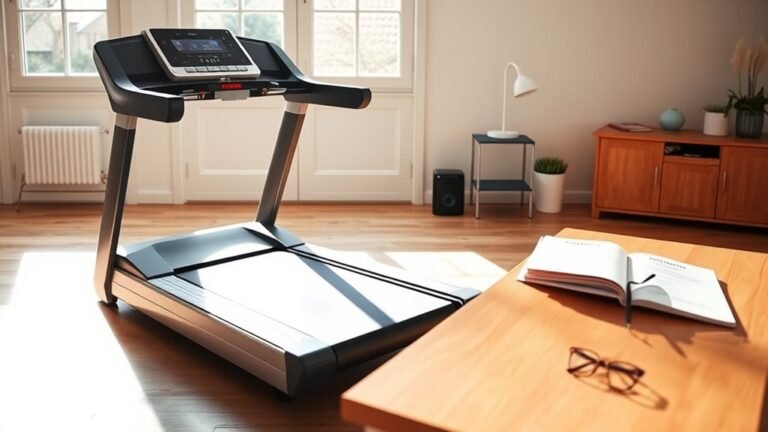
How Does a Treadmill Work
How Does a Treadmill Work? When you use a treadmill, its motor powers a moving belt that simulates walking or running at set speeds and inclines. This lets you control workout intensity accurately.
Sensors track your speed, distance, and heart rate, feeding data to the console. Safety features like emergency stops protect you during exercise.
Regular maintenance guarantees smooth, reliable operation. Understanding how these components work together can enhance your exercise experience and optimize treadmill performance effectively.
Key Takeaways
- A treadmill uses a motor-driven belt to simulate walking or running by moving under the user’s feet continuously.
- The motor’s power controls belt speed and ensures smooth, consistent motion for effective workouts.
- Sensors track speed, distance, and incline to provide accurate exercise metrics and adjust settings.
- The running deck and frame support the user while rollers guide the belt’s smooth rotation.
- Safety features like emergency stops and safety keys prevent accidents during treadmill use.
How a Treadmill Works: The Basics
A treadmill operates through a motor-driven belt that continuously moves beneath your feet, simulating walking or running. This mechanism allows you to maintain consistent speed and incline, optimizing workout efficiency.
By controlling the belt’s velocity and incline, you can tailor exercise intensity, enhancing treadmill benefits such as cardiovascular improvement and calorie burning. The motor’s power output directly influences the belt’s smoothness and responsiveness, essential for a stable workout environment.
Sensors monitor belt speed and user input, enabling precise adjustments to maintain target pace. This continuous, controlled motion reduces impact stress compared to outdoor running, minimizing injury risk.
Understanding this fundamental operation helps you maximize treadmill benefits, ensuring effective, consistent workouts that align with your fitness goals.
What Are the Main Parts of a Treadmill
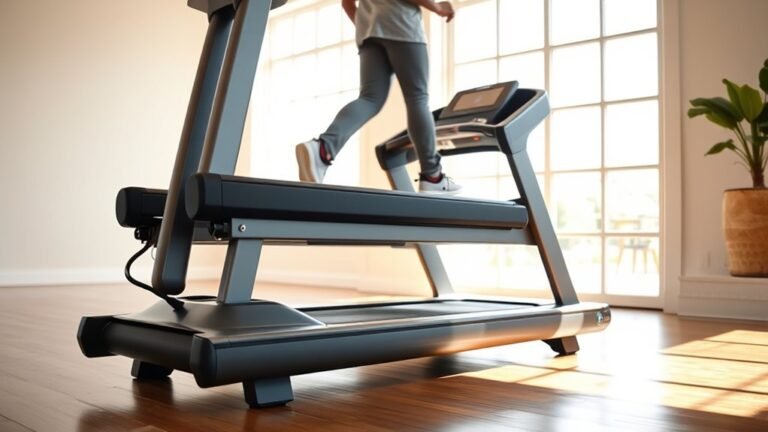
Understanding the main parts of a treadmill is crucial for grasping how the machine functions and how to maintain it effectively. In treadmill design, the core components include the running deck, belt, frame, console, and rollers.
The running deck provides a stable platform, while the belt moves continuously for your workout. The frame guarantees structural integrity, supporting all treadmill types, from manual to motorized.
The console displays speed, time, and other metrics, allowing you to control settings with precision. Rollers guide and stabilize the belt’s motion, critical for smooth operation.
Each part’s interaction determines performance and durability, so recognizing these elements helps you troubleshoot and maintain your treadmill efficiently.
Understanding this framework prepares you for deeper insights into treadmill mechanics and maintenance.
How the Motor Powers and Controls the Treadmill Belt
The motor serves as the powerhouse that drives the treadmill belt, converting electrical energy into mechanical motion.
The motor powers the treadmill belt by transforming electrical energy into smooth mechanical motion.
You rely on the motor torque to overcome belt friction, guaranteeing smooth and consistent belt movement.
The motor’s power output directly controls the belt’s speed, allowing precise adjustments during your workout.
A control system modulates voltage and current to regulate torque, matching your speed settings.
Proper alignment and tension mitigate excessive friction, enhancing efficiency and motor lifespan.
- Motor torque overcomes belt friction
- Electrical input converts to mechanical rotation
- Speed control via voltage modulation
- Belt tension affects friction and motor load
- Continuous feedback guarantees consistent belt velocity
Understanding this interaction helps you appreciate how the motor powers and controls the treadmill belt with precision and reliability.
How Treadmill Sensors Track Speed, Distance, and More
While the motor drives the belt, treadmill sensors continuously monitor its speed and distance to provide accurate workout data. These sensors use advanced sensor technology, such as magnetic or optical encoders, to detect belt rotation and convert it into quantifiable workout metrics.
You rely on this data for pace, distance, and calorie calculations. The sensors also track incline changes and user input for thorough monitoring.
| Sensor Type | Function | Output Metric |
|---|---|---|
| Optical Encoder | Measures belt rotations | Speed, Distance |
| Incline Sensor | Detects treadmill slope | Incline Level |
| Heart Rate Sensor | Monitors user pulse rate | Calorie Burn Rate |
This precise sensor feedback guarantees your treadmill delivers reliable and consistent workout analytics.
Using the Treadmill Control Panel to Customize Your Workout
How can you tailor your treadmill workout to match your fitness goals and preferences? The treadmill control panel offers a precise interface to customize your exercise through adjustable workout programs and display settings.
Customize your treadmill workout effortlessly using adjustable programs and display settings tailored to your fitness goals.
By selecting specific programs, you can target endurance, interval training, or calorie burning with pre-set speed and incline variations.
The display settings allow you to monitor real-time metrics such as pace, distance, and heart rate, facilitating data-driven adjustments.
Key customization features include:
- Choosing from diverse workout programs tailored to fitness objectives
- Adjusting speed and incline with fine increments
- Setting target goals for time, distance, or calories
- Monitoring workout progress on customizable display settings
- Saving personalized workouts for consistent training
Leveraging these controls guarantees efficient and goal-oriented treadmill sessions.
Treadmill Safety Features That Protect You While Exercising
Because safety is paramount during any workout, treadmills incorporate multiple features designed to minimize risk and prevent injury. One critical element is the emergency stop mechanism, which immediately halts the belt’s motion when activated, preventing falls or overexertion.
You’ll typically engage this via a large, easily accessible button or a tethered safety key clipped to your clothing. The safety key serves as a fail-safe; if it detaches, such as if you stumble, the treadmill automatically stops. This feature guarantees that you don’t continue running unattended or in a compromised state.
Additionally, treadmills often include side rails for stability and speed limit controls to prevent sudden acceleration.
Together, these safety features create a controlled environment that actively protects you throughout your exercise session.
Essential Maintenance Tips to Keep Your Treadmill Running Smoothly
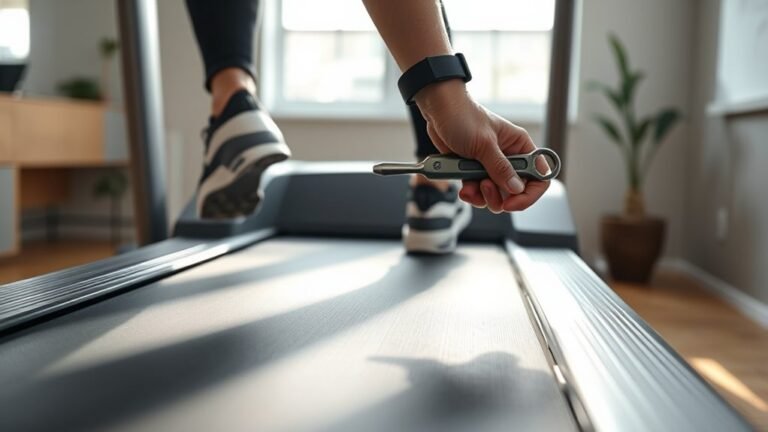
To keep your treadmill operating efficiently, you need to regularly lubricate the belt and clean debris from the deck area.
Monitoring belt tension and alignment prevents premature wear and motor strain.
Consistent motor maintenance guarantees peak performance and extends the machine’s lifespan.
Lubrication And Cleaning
Although treadmills are engineered for durability, neglecting lubrication and cleaning can lead to premature wear and performance issues.
You need to apply proper lubrication techniques to reduce friction between the belt and deck, ensuring smooth operation.
Follow the manufacturer’s recommended cleaning frequency to prevent dust and debris buildup, which can impair treadmill function.
Key maintenance actions include:
- Use silicone-based lubricant as specified by the manufacturer
- Clean the treadmill belt and deck weekly to remove dust and sweat
- Vacuum around and under the treadmill monthly to prevent dust accumulation
- Wipe down the console and handrails with a damp cloth after each use
- Inspect and clean air vents regularly to maintain motor cooling efficiency
Adhering to these precise lubrication and cleaning practices will extend your treadmill’s lifespan and optimize its performance.
Belt And Motor Care
Maintaining proper lubrication and cleanliness sets the foundation for effective belt and motor care in your treadmill.
Focus on consistent belt maintenance by regularly checking tension and alignment; an improperly adjusted belt increases friction, accelerating wear and reducing motor efficiency.
Use manufacturer-recommended lubricants to minimize surface resistance and extend belt lifespan.
For motor inspection, disconnect power before examining the motor housing for dust accumulation and debris, which can cause overheating.
Confirm cooling vents remain unobstructed to maintain ideal thermal conditions.
Listen for unusual noises indicating bearing or motor wear.
Regularly inspect electrical connections for corrosion or looseness to prevent performance degradation.
Frequently Asked Questions
Can I Use a Treadmill Outdoors?
You can use some treadmills outdoors if they have adequate treadmill portability features, like wheels and lightweight design. However, exposure to weather and uneven surfaces may affect performance, so consider a model specifically designed for outdoor workout use.
How Much Electricity Does a Treadmill Consume?
Your treadmill’s power consumption gently hums around 600 to 700 watts during use. To maximize energy efficiency, you should monitor settings, maintain the motor, and consider variable speed models that optimize electricity consumption precisely.
Are Treadmills Suitable for People With Joint Pain?
Yes, treadmills offer joint pain relief by providing low impact exercise. Their cushioned belts reduce stress on joints compared to hard surfaces, making them suitable for controlled, repetitive motion beneficial in managing joint discomfort effectively.
What Is the Average Lifespan of a Treadmill?
You probably expect a treadmill to last forever, right? Typically, its lifespan is 7-12 years, depending on treadmill maintenance quality and usage.
Don’t forget to check your treadmill warranty for coverage specifics and replacement policies.
Can Treadmill Workouts Help With Weight Loss?
Yes, treadmill workouts offer significant treadmill benefits by increasing your heart rate and calorie burn, which supports weight loss. Consistent use, combined with proper intensity and duration, optimizes fat reduction and enhances metabolic rate effectively.
Conclusion
Now that you understand how a treadmill’s motor, sensors, and control panel work together like a well-oiled machine, you can optimize your workouts with precision. By regularly maintaining your treadmill and respecting its safety features, you guarantee it runs smoothly—just like clockwork.
Think of your treadmill as a finely tuned instrument, ready to deliver consistent performance every time you step on. With this knowledge, you’re equipped to get the most out of every session.
Understanding how a treadmill works helps you maximize its benefits and ensures a safe, effective workout every time.