Is Running on a Treadmill Easier
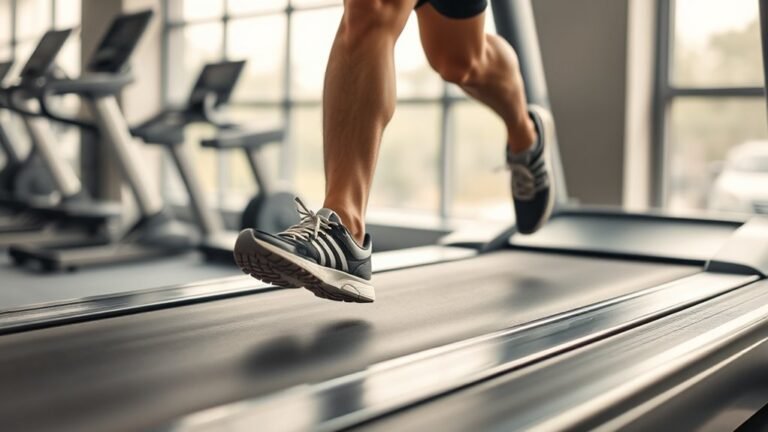
Is running on a treadmill easier? You’ll likely find treadmill running easier because it offers a controlled environment—no wind resistance or uneven terrain to slow you down. The moving belt helps propel your feet, reducing effort compared to outdoor surfaces.
Plus, consistent pacing and cushioned surfaces lower joint stress and make running feel less taxing. However, factors like incline and workout design can alter difficulty.
If you want to understand the nuances and how to optimize your treadmill sessions, keep exploring.
Key Takeaways
- Treadmill running feels easier due to the belt propelling your feet backward, reducing energy expenditure compared to outdoor running.
- Controlled speed and incline settings on treadmills allow for consistent pacing without environmental interruptions.
- Absence of wind resistance and variable terrain indoors lowers physiological stress and perceived effort.
- Cushioning on treadmill surfaces reduces joint impact but may alter natural running mechanics slightly.
- Calorie burn on treadmills is generally similar but can be slightly lower than outdoor running due to reduced stabilizing muscle engagement.
Is Treadmill Running Easier Than Outdoor Running?
How does treadmill running compare to outdoor running regarding difficulty?
Treadmill running offers controlled conditions, which provide several treadmill advantages. You can set an exact pace, incline, and avoid environmental factors like wind or uneven terrain.
This consistency reduces variability in your workout intensity. Conversely, outdoor challenges include variable surfaces, weather conditions, and wind resistance, all of which increase physical demand and require greater energy expenditure.
While both modalities engage similar muscle groups, the stability and predictability of treadmill running may alter biomechanical patterns and perceived effort.
So, while treadmill running eliminates some external variables, it demands sustained effort at a fixed pace.
Understanding these differences helps you tailor training to your goals, balancing treadmill advantages with outdoor challenges for a thorough running regimen.
Why Treadmill Running Often Feels Easier Than Outdoor Running
Although treadmill running and outdoor running engage similar muscles and require consistent effort, many runners find treadmill sessions feel easier. This perception stems from several treadmill advantages.
On a treadmill, the belt propels your feet backward, reducing the energy needed for leg turnover compared to pushing off the ground outdoors. Additionally, you control speed and incline precisely, allowing steady pacing that promotes running consistency without external interruptions like terrain variability or wind resistance.
Treadmills aid leg turnover with a moving belt and offer precise speed and incline control for consistent pacing.
Environmental factors such as weather and uneven surfaces are absent indoors, further lowering physiological stress. These controlled conditions reduce metabolic demand, making treadmill running feel less taxing despite comparable cardiovascular effort.
Understanding these factors helps you appreciate why treadmill running often feels easier, even though it demands similar physical exertion as outdoor running.
How Treadmill Surface and Cushioning Affect Your Running Effort
Since treadmill surfaces vary in material and cushioning, they greatly influence the mechanical load on your muscles and joints during running.
Understanding these surface variations helps you gauge effort and injury risk more accurately.
Cushioning benefits reduce impact forces, lessening joint strain compared to harder outdoor terrains.
However, excessive cushioning can alter your natural gait, potentially increasing energy expenditure.
Key factors to evaluate include:
- Thickness and density of the treadmill deck
- Material composition affecting shock absorption
- Surface texture influencing traction and stability
- Degree of cushioning benefits balancing comfort and biomechanics
- Durability of surface affecting consistent running mechanics
Why Wind and Hills Make Outdoor Running Harder
When you run outdoors, wind resistance forces your body to work harder to maintain speed, increasing energy expenditure and muscle fatigue. Additionally, incline variation from hills demands greater muscular effort and cardiovascular output. Both factors combine to elevate workout intensity compared to treadmill running, where you face no wind and can set a consistent incline.
| Factor | Effect on Effort | Physiological Impact |
|---|---|---|
| Wind resistance | Increases drag | Raises oxygen consumption |
| Uphill incline | Requires more force | Enhances muscle recruitment |
| Downhill slope | Decreases effort | Affects joint impact |
| Variable terrain | Demands balance control | Engages stabilizer muscles |
| Outdoor elements | Unpredictable conditions | Increases mental focus |
Understanding these variables helps explain why outdoor running often feels harder than treadmill workouts.
How Pacing on a Treadmill Changes Your Workout Intensity
Adjusting your pace on a treadmill directly influences your workout intensity by controlling the workload your cardiovascular and muscular systems must sustain.
By employing varied pacing strategies, you can precisely modulate exercise difficulty and target specific fitness adaptations.
For example, consistent steady-state pacing promotes aerobic endurance, while interval pacing alternates high and low intensities to enhance anaerobic capacity.
Understanding how to adjust your treadmill speed allows you to tailor workout variations for ideal results.
Gradual speed increases improve cardiovascular efficiency.
Interval pacing boosts metabolic rate and calorie burn.
Variable pacing reduces monotony and enhances motivation.
Controlled speed changes prevent overtraining and injury.
Precise pacing enables targeted training zones for heart rate.
Mastering treadmill pacing strategies empowers you to customize workout intensity effectively.
Does Treadmill Running Burn Fewer Calories Than Outdoor Running?
You might wonder if running on a treadmill burns fewer calories than running outdoors.
Factors like environmental conditions and subtle differences in running mechanics can influence your energy expenditure.
Understanding these elements helps you optimize your workout regardless of where you run.
Calorie Burn Comparison
How does running on a treadmill compare to outdoor running with respect to calorie burn? Generally, both modes can yield similar calorie burn if you maintain comparable exercise intensity. However, subtle differences exist due to environmental and biomechanical factors.
- Outdoor running demands more energy to overcome wind resistance.
- Treadmill belts assist leg turnover, potentially reducing effort.
- Adjusting treadmill incline can simulate outdoor terrain, increasing calorie burn.
- Variations in running surface stiffness affect muscle activation.
- Controlled treadmill settings may limit natural pace fluctuations impacting exercise intensity.
When you run outdoors, your body works harder to stabilize and adapt, often leading to slightly higher calorie burn.
Yet, by manipulating treadmill speed and incline, you can match or exceed outdoor exercise intensity, ensuring effective calorie expenditure during your workout.
Environmental Impact Factors
Although treadmill running offers a controlled environment, it lacks certain external factors present outdoors that influence energy expenditure. When you run outside, variables like wind resistance, terrain, and temperature fluctuations increase your calorie burn.
Conversely, treadmills require electrical power, leading to treadmill emissions and energy consumption. Understanding these environmental impact factors helps you evaluate the true cost of your workout.
| Factor | Outdoor Running |
|---|---|
| Wind Resistance | Present |
| Terrain Variation | Present |
| Temperature Changes | Present |
| Energy Consumption | None |
| Treadmill Emissions | None |
Outdoor running naturally increases energy expenditure without electrical energy use, whereas treadmill running consumes energy and emits indirect environmental costs.
Running Mechanics Differences
Because treadmill belts assist leg turnover, running mechanics differ considerably from outdoor running, which affects calorie burn. When you run on a treadmill, your running form adjusts to the consistent, moving surface, altering your treadmill stride compared to natural terrain.
This mechanical difference impacts muscle engagement and energy expenditure. Key distinctions include:
- Reduced need for propulsive force due to belt movement
- Shorter, more uniform treadmill stride length
- Less activation of stabilizing muscles from lack of terrain variability
- Altered foot strike patterns to accommodate belt speed
- Decreased air resistance, lowering overall effort
These factors mean that your body works differently on a treadmill, which can lead to a slight reduction in calories burned compared to outdoor running with varied running form demands.
When Treadmill Running Can Actually Be More Challenging
Even when you maintain a steady pace, running on a treadmill can demand more from your muscles and cardiovascular system than outdoor running. This increased challenge often arises when you incorporate treadmill incline settings, which simulate uphill running and intensify muscular engagement, particularly in your calves, quadriceps, and glutes.
Additionally, treadmill running can subtly alter your running form; without natural propulsion from wind resistance and terrain variation, you might unconsciously adjust your posture or stride, increasing energy expenditure.
The consistent belt speed also means you can’t rely on external cues to regulate effort, potentially leading to higher cardiovascular strain.
Consequently, while treadmill running offers controlled conditions, these factors can make it physically more demanding, requiring you to focus carefully on maintaining proper running form to avoid injury and maximize efficiency.
Tips to Make Your Treadmill Workouts More Effective and Challenging
To maximize the benefits of treadmill running, you should incorporate varied workout strategies that target different muscle groups and energy systems.
Employing interval training on the treadmill can enhance cardiovascular efficiency and muscle endurance by alternating high-intensity bursts with recovery periods.
Adjusting incline settings simulates outdoor terrain, increasing muscle activation, especially in the glutes and calves.
To make your treadmill workouts more effective and challenging, consider these tips:
- Use interval training to boost aerobic and anaerobic capacity.
- Incorporate varied incline settings to engage different muscle groups.
- Adjust speed dynamically to simulate real-world conditions.
- Include strength exercises, like walking lunges, during cool-down.
- Monitor heart rate to maintain ideal training zones.
Frequently Asked Questions
Can Treadmill Running Reduce the Risk of Injury Compared to Outdoor Running?
Yes, treadmill running can reduce injury risk by offering better impact absorption and controlled environments, aiding injury prevention.
You’ll experience less joint stress compared to uneven outdoor surfaces, lowering the chance of strains and overuse injuries.
How Does Treadmill Running Affect Joint Health Over Time?
You’ll experience reduced joint impact on a treadmill due to its cushioning, which supports joint health over time. This can provide long term benefits by minimizing wear and tear compared to harder outdoor surfaces.
Are Treadmills Suitable for Interval Training and Sprints?
Absolutely, you can efficiently execute interval exercises using treadmill benefits, boosting sprint effectiveness. The treadmill’s controlled environment allows precise pace adjustments, enhancing training intensity and consistency.
This makes it scientifically sound for structured sprint and interval workouts.
What Are the Best Treadmill Settings for Beginners?
You should start with low speed settings around 2-3 mph and a treadmill incline of 1-2% to simulate outdoor running.
Gradually increase intensity to improve endurance while minimizing injury risk and maximizing workout efficiency.
Can Treadmill Running Improve Running Form or Technique?
You can transform your running mechanics dramatically on a treadmill, almost like rewiring your body’s blueprint. By focusing on posture alignment and controlled strides, you fine-tune technique scientifically, enhancing efficiency and reducing injury risk effectively.
Conclusion
Running on a treadmill might feel like a gentle breeze compared to the unpredictable gusts of outdoor running, but that doesn’t mean it’s always easier. Factors like surface cushioning, lack of wind resistance, and controlled pacing influence your effort and calorie burn.
By adjusting incline and speed, you can turn your treadmill workout into a rigorous challenge. Understanding these dynamics helps you tailor your training for maximum efficiency, whether indoors or outside.
In conclusion, knowing whether running on a treadmill is easier depends on how you use the machine. With the right settings, running on a treadmill can be just as demanding and effective as outdoor running.