Why Does Running on a Treadmill Feel Harder
You feel running on a treadmill is harder because your body adapts to the treadmill’s consistent surface and belt movement, which alters your stride and demands more muscular effort. The repetitive motion requires muscles to work differently compared to outdoor running, often increasing fatigue.
The lack of natural airflow and outdoor sensory cues increases your perceived exertion and mental fatigue, making the effort seem tougher. Without wind resistance and changing scenery, your brain has fewer distractions, leading to a heightened sense of effort.
Additionally, you need greater cognitive control to maintain pace on the treadmill, adding mental strain. Understanding these factors can help you optimize your treadmill workouts for better results and improved endurance.
Key Takeaways
- Lack of natural environmental stimuli and visual flow increases perceived exertion and mental fatigue during treadmill running.
- Consistent treadmill pace requires more cognitive control, limiting natural speed variations and making running feel harder.
- Uniform treadmill surface alters stride mechanics, increasing muscular effort due to biomechanical adjustments.
- Absence of air resistance on treadmills reduces muscle engagement diversity, contributing to increased exertion perception.
- Monotony and limited sensory input on treadmills heighten boredom and perceived difficulty compared to outdoor running.
Why Running on a Treadmill Feels Harder Than Outdoors
Although treadmill running eliminates variables like terrain changes and wind resistance, you often find it feels more challenging due to the lack of natural environmental feedback and altered biomechanics.
Research shows that this absence of visual flow and external stimuli disrupts your running psychology, increasing perceived exertion and contributing to treadmill fatigue.
Without landmarks or changing scenery, your brain receives less sensory information, which can heighten feelings of monotony and mental fatigue.
Additionally, the consistent pace set by the treadmill limits your natural speed fluctuations, demanding greater cognitive control and causing earlier onset of fatigue.
Studies suggest that these psychological factors, combined with the altered sensory input, explain why treadmill running often feels harder despite the controlled conditions.
Understanding this can help you adjust your mindset and training approach effectively.
How Biomechanics and Treadmill Surface Affect Your Stride
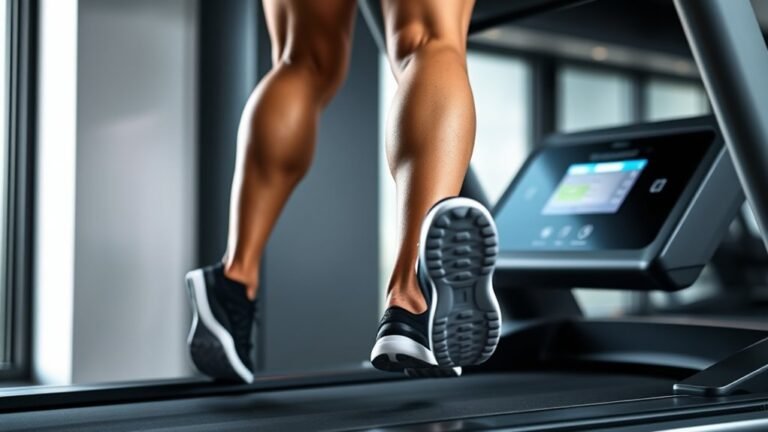
Because the treadmill surface differs markedly from outdoor terrain, it directly influences your running biomechanics and stride mechanics. The treadmill’s consistent, often cushioned surface reduces variability in surface traction, altering how your foot strikes and pushes off.
Unlike outdoor running, where varied traction demands constant micro-adjustments, treadmill belts provide a uniform grip that can disrupt your natural stride rhythm. Research shows this can lead you to adopt a shorter stride length and higher cadence to maintain stability.
Additionally, the treadmill’s moving belt forces your foot to land differently, affecting joint angles and muscle activation patterns. These biomechanical adjustments increase muscular effort and can contribute to the perception that treadmill running feels harder, as your body works to compensate for the altered stride mechanics and reduced proprioceptive feedback.
How Air Resistance Makes Outdoor Running Easier
When you run outdoors, your body encounters air resistance that influences your energy expenditure differently than on a treadmill. As you move forward, air flow creates a drag force opposing your motion, requiring your muscles to work harder to maintain speed.
However, this resistance varies with outdoor conditions such as wind speed and direction, sometimes providing a natural break when it’s at your back.
Additionally, terrain differences outdoors, like slight inclines or uneven surfaces, engage stabilizing muscles more effectively, promoting a more natural running form.
On a treadmill, the lack of air flow means your body doesn’t expend energy overcoming drag, but the consistent, flat surface limits muscle engagement diversity.
Consequently, outdoor running’s variable air resistance and terrain make it biomechanically and energetically distinct from treadmill running.
Why Mental Focus and Boredom Make Treadmill Running Tougher
While treadmill running removes many external distractions, it demands heightened mental focus to maintain pace and form. This sustained concentration can accelerate mental fatigue, making the exercise feel more strenuous than outdoor running.
Unlike varied outdoor environments that naturally engage your attention, the treadmill’s monotonous setting offers limited sensory input, increasing boredom and perceived exertion. Studies show that mental fatigue reduces your endurance by impairing motivation and increasing perceived effort.
You might find it harder to distract yourself from discomfort or fatigue without natural stimuli. Although distraction techniques like listening to music or watching videos can help, their effectiveness varies and may not fully counteract the cognitive load treadmill running imposes.
Understanding this mental challenge explains why treadmill sessions often feel tougher despite controlled physical conditions.
Tips to Adjust Your Treadmill Workouts for Less Fatigue
You can reduce treadmill fatigue by optimizing your speed and incline to match your fitness level, which helps manage energy expenditure more efficiently.
Focusing on proper running form minimizes unnecessary muscle strain and improves oxygen utilization.
Additionally, incorporating interval training boosts cardiovascular endurance and breaks monotony, making your workouts less taxing overall.
Optimize Speed And Incline
Although treadmill workouts often feel more taxing than outdoor runs, adjusting speed and incline settings can greatly reduce perceived effort.
Research shows that incorporating a slight incline, typically 1-2%, mimics outdoor running conditions by compensating for the lack of wind resistance and natural terrain variation.
This adjustment leverages incline benefits, allowing you to maintain a comfortable pace while enhancing cardiovascular efficiency. Instead of running flat at high speeds, experiment with moderate speeds combined with a gentle incline to balance exertion.
Fine-tuning these treadmill settings can optimize your workout intensity without unnecessary fatigue. By calibrating speed and incline thoughtfully, you reduce metabolic strain and improve endurance, making treadmill exercise more sustainable and less mentally demanding.
This evidence-based approach transforms your treadmill sessions into effective and manageable training.
Focus On Proper Form
Since treadmill running eliminates natural variations in terrain, maintaining proper form becomes essential to reduce fatigue and injury risk. You should focus on proper posture by keeping your head aligned over your shoulders and your shoulders relaxed to avoid unnecessary muscle tension.
Engaging your core stabilizes your body, enhancing stride efficiency and reducing energy expenditure. Additionally, aim for a midfoot strike to promote smoother changes and lessen impact forces.
Avoid overstriding, which can disrupt your gait mechanics and increase fatigue. Scientific studies show that consistent attention to these biomechanical factors on the treadmill improves oxygen consumption and delays fatigue onset.
Incorporate Interval Training
Mastering proper form sets a solid foundation, but varying your treadmill routine further enhances performance and reduces fatigue. Incorporating interval training optimizes your workout by alternating high-intensity bursts with recovery periods, improving cardiovascular efficiency and muscle endurance.
To effectively implement interval training, consider these three evidence-based strategies:
- Adjust interval duration to match your fitness level. Use shorter intervals (30 seconds to 1 minute) for beginners and longer intervals (2 to 4 minutes) for advanced runners.
- Utilize active recovery periods by slowing your pace rather than stopping, promoting sustained blood flow and faster lactate clearance.
- Gradually increase intensity during intervals to prevent premature fatigue and maintain consistent effort throughout your session.
This structured approach balances exertion and rest, mitigating treadmill-induced fatigue and enhancing overall workout quality.
When to Choose Treadmill Running Versus Outdoor Runs
When should you opt for treadmill running instead of hitting the outdoors? Treadmill benefits become clear when weather conditions, safety concerns, or time constraints limit outdoor activity.
Controlled environments reduce injury risk by providing consistent surfaces and adjustable pacing, which is especially useful for rehabilitation or interval training.
Conversely, outdoor preferences often hinge on varied terrain and fresh air, which contribute to enhanced proprioception and motivation, as supported by several studies.
If you seek to improve your running economy or enjoy natural stimuli, outdoor runs might better suit you.
However, when precision, convenience, or environmental factors interfere, treadmill sessions offer reliable alternatives.
Ultimately, your choice should align with your goals, physical condition, and environmental context to optimize training outcomes effectively.
How to Get the Most Out of Your Indoor Running Sessions
Choosing treadmill running offers unique advantages, but to fully leverage indoor sessions, you need strategies that address common challenges like monotony and altered biomechanics.
To maximize the effectiveness of your treadmill workouts and sustain indoor motivation, consider these evidence-based approaches:
- Vary your speed and incline: Research shows that interval training and hill simulations enhance cardiovascular benefits and reduce perceived exertion.
- Incorporate real-time feedback: Use treadmill metrics and wearable tech to monitor pace, heart rate, and form, promoting biomechanical efficiency.
- Engage your mind: Mental engagement through music, virtual courses, or goal-setting counters monotony and improves adherence.
Frequently Asked Questions
Can Treadmill Running Help Improve My Overall Running Speed?
Yes, treadmill speed training can enhance your running efficiency by allowing controlled pace adjustments and consistent form practice.
Scientific studies show this improves neuromuscular coordination, ultimately boosting your overall running speed effectively and measurably.
Is Treadmill Running Better for Injury Recovery?
You don’t need a quill to know treadmill benefits include controlled speed and cushioning, which support injury prevention.
Evidence shows treadmill running aids recovery by reducing impact forces, letting you rebuild strength safely and steadily after injury.
How Does Treadmill Incline Affect Calorie Burn?
When you increase treadmill settings by adding incline, you boost calorie burn markedly. Incline benefits include engaging more muscle groups and elevating cardiovascular demand, making your workout more efficient and scientifically proven to enhance energy expenditure.
Are There Specific Shoes Recommended for Treadmill Running?
Of course, you don’t need special shoes just kidding! You should choose treadmill shoes with excellent cushioning and arch support to absorb impact and maintain foot stability. This enhances comfort and reduces injury risk during indoor running sessions.
Can Treadmill Workouts Improve My Marathon Performance?
You can improve your marathon training by using treadmill pacing to maintain consistent speed and control intensity. Scientific studies show treadmill workouts enhance endurance, running economy, and help simulate race conditions effectively for better marathon performance.
Conclusion
Think of treadmill running like cycling against a stationary fan—you’re pedaling hard but not quite moving forward, which demands more effort. Studies show treadmill runners expend up to 5% more energy than outdoor runners due to altered biomechanics and lack of wind resistance.
By understanding these factors and adjusting your pace, incline, and mental focus, you can optimize your indoor sessions. This approach helps in turning that “harder” feeling into a more efficient, purposeful workout.
Ultimately, knowing why running on a treadmill feels harder allows you to tailor your training and improve performance indoors.