How to Grease a Treadmill Belt
To grease a treadmill belt, start by unplugging the machine to ensure safety. Next, clean the deck area thoroughly to remove any dust or debris.
Gently lift the belt near the rear roller without forcing it. Apply a silicone-based lubricant evenly between the belt and deck—never on the belt surface itself.
Manually rotate the belt at least 10 times to spread the lubricant thoroughly. It’s best to lubricate every 3 to 6 months or after about 40-50 hours of use.
Following these steps guarantees smooth operation and longevity. You can explore more tips to optimize maintenance.
Key Takeaways
- Use a silicone-based lubricant specifically designed for treadmills; avoid petroleum-based oils to prevent damage.
- Unplug the treadmill, lift the belt near the rear roller, and clean the deck thoroughly before applying lubricant.
- Apply lubricant evenly to the underside of the belt between the belt and deck, avoiding direct application on the belt surface.
- Manually rotate the belt at least 10 full revolutions to distribute the lubricant evenly and prevent dry spots.
- Lubricate every 3 to 6 months or every 40 to 50 hours of use, adjusting for dust, humidity, and treadmill performance.
Signs Your Treadmill Belt Needs Lubricating
How do you know when your treadmill belt needs lubricating? You’ll notice specific lubrication signs indicating it’s time for treadmill maintenance.
First, listen for unusual squeaking or friction noises during operation. These sounds mean the belt’s surface and deck lack sufficient lubrication.
Listen for unusual squeaks or friction noises—these signal your treadmill belt needs lubrication.
Next, observe increased resistance when walking or running, suggesting the belt is rubbing against the deck more than usual. You may also see belt slipping or inconsistent speed, which points to inadequate lubrication.
Check for visible dryness or roughness on the belt’s underside.
Regularly inspecting these signs guarantees you maintain ideal treadmill performance and prevents premature wear. Addressing lubrication needs promptly extends your treadmill’s lifespan and maintains smooth, efficient function.
What Lubricant Works Best for Treadmill Belts
You should use silicone-based lubricants because they reduce friction without damaging the belt or deck.
Avoid petroleum-based oils, as they can degrade treadmill components over time.
Apply the lubricant every three to six months, depending on your treadmill’s usage and manufacturer guidelines.
Silicone-Based Lubricants Benefits
Selecting the right lubricant is essential for maintaining your treadmill’s performance and longevity. Silicone-based lubricants offer several advantages that make them ideal for treadmill belts. Their unique formula reduces friction effectively while resisting heat and wear.
When applying silicone lubricants, follow these lubrication tips for best results:
- Verify the belt and deck are clean before application.
- Apply a thin, even layer to avoid excess buildup.
- Use only treadmill-specific silicone lubricants to prevent damage.
- Lubricate every 3-6 months or as recommended by the manufacturer.
- Avoid over-lubrication, which can cause belt slippage.
Silicone advantages include long-lasting lubrication, compatibility with various treadmill materials, and resistance to drying out, guaranteeing smooth, quiet operation.
Avoiding Petroleum-Based Oils
While silicone-based lubricants excel in treadmill maintenance, petroleum-based oils can cause significant issues when used on treadmill belts. Petroleum oils degrade belt material, attract dust, and reduce motor efficiency, contradicting common lubrication myths.
Instead, opt for approved oil alternatives like silicone or Teflon-based lubricants. These maintain ideal belt flexibility and reduce friction without damaging components.
| Lubricant Type | Effect on Belt Material | Dust Attraction |
|---|---|---|
| Petroleum-Based | Degrades rubber | High |
| Silicone-Based | Preserves integrity | Low |
| Teflon-Based | Enhances smoothness | Minimal |
Avoid petroleum oils to promote longevity and performance. Use oil alternatives explicitly designed for treadmills to maintain operational efficiency and prevent premature wear.
Recommended Application Frequency
Applying lubricant to your treadmill belt every 3 to 6 months guarantees maximum performance and longevity. Establishing a consistent lubrication schedule helps prevent belt wear and motor strain.
Follow these application tips for best results:
- Clean the deck thoroughly before each lubrication.
- Use silicone-based lubricants designed specifically for treadmill belts.
- Apply lubricant evenly under the belt edges to avoid buildup.
- Avoid over-lubrication, which can cause slippage and damage.
- Monitor belt condition monthly to adjust frequency as needed.
Stick to this schedule based on your treadmill’s usage intensity. High-usage machines require more frequent lubrication, while occasional users may extend intervals up to six months.
Proper timing and application guarantee smooth operation, reducing maintenance costs and extending equipment life.
Tools and Materials Needed to Grease Your Treadmill Belt
To grease your treadmill belt effectively, you’ll need a few essential tools and materials prepared beforehand.
First, obtain a silicone-based treadmill lubricant specifically designed for treadmill maintenance; avoid petroleum-based products as they can damage the belt.
Next, have a clean, lint-free cloth to wipe debris from the belt and deck. You’ll also need a flathead screwdriver or Allen wrench to lift the belt edges safely during lubrication.
Additionally, keep disposable gloves on hand to protect your skin and prevent contamination. A small applicator bottle or a syringe can help apply lubricant precisely, supporting proper lubrication techniques.
Having these tools and materials ready guarantees you perform treadmill belt maintenance accurately, prolonging your machine’s lifespan and maintaining peak performance.
How to Unplug and Prepare Your Treadmill for Lubrication
Before lubricating your treadmill belt, you must unplug the machine to guarantee safety and prevent accidental startup. Prioritizing treadmill safety during preparation steps protects you from electrical hazards and mechanical injuries.
Follow these precise actions to prepare your treadmill:
- Disconnect the power cord from the electrical outlet.
- Wait at least five minutes to allow internal components to discharge.
- Clear the surrounding area to prevent tripping or interference.
- Inspect the belt and deck for debris or damage.
- Position the treadmill on a stable, level surface to guarantee even lubrication.
Completing these preparation steps guarantees a safe environment and ideal lubrication conditions.
Always verify the treadmill remains unplugged throughout the process to avoid any unexpected activation. This careful preparation minimizes risk and enhances the effectiveness of your maintenance.
How to Lift the Treadmill Belt Safely
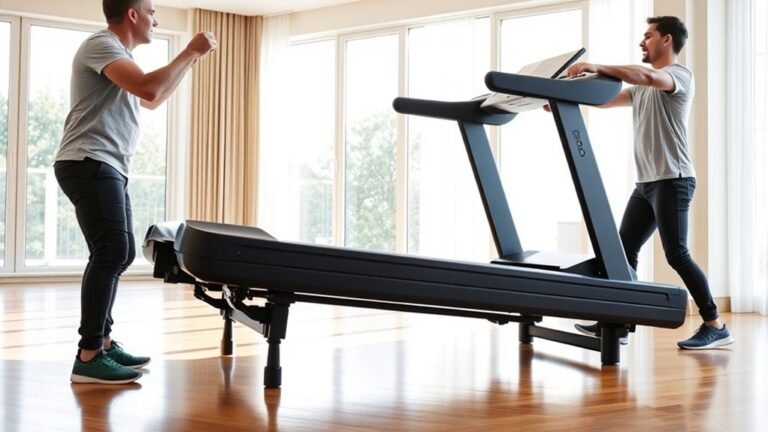
Although the treadmill belt may seem difficult to lift, you can safely access the deck by carefully loosening the belt edges. First, verify the treadmill is unplugged to maintain treadmill safety.
Locate the belt’s sides and gently lift one edge using your fingertips, applying even pressure to avoid damaging the belt or deck. Use proper lifting techniques by supporting the belt with both hands to prevent strain or sudden slips.
Avoid pulling or forcing the belt upward; instead, gradually create enough space to access the deck beneath. Maintain a steady grip and avoid sharp movements to protect the treadmill’s components.
Following these steps guarantees you lift the treadmill belt safely, minimizing the risk of injury and preserving the machine’s integrity during maintenance.
How to Apply Lubricant Evenly Under the Belt
Once you’ve lifted the treadmill belt safely, you’ll want to apply the lubricant evenly to guarantee smooth operation and prevent wear.
Proper belt maintenance requires precise lubrication techniques to avoid buildup or uneven distribution.
Follow these steps for even application:
- Use a manufacturer-recommended silicone-based lubricant.
- Apply a thin, continuous bead along the length of the deck, not the belt.
- Start from the middle, then move toward each side to cover the full width.
- Avoid over-lubricating; excessive lubricant can cause belt slippage.
- After application, lower the belt gently to avoid displacing the lubricant.
Consistent, even application promotes ideal friction reduction and extends the treadmill’s lifespan.
Stick to this method for effective belt maintenance.
How to Rotate the Treadmill Belt to Spread Grease
To evenly distribute the lubricant, you’ll need to manually rotate the treadmill belt by hand.
Grasp the belt firmly and turn it slowly to spread the grease uniformly beneath the surface.
This technique guarantees peak performance and prevents uneven wear on the belt and deck.
Manual Belt Rotation Techniques
Manual belt rotation is essential for evenly distributing grease beneath the treadmill belt. To perform manual rotation correctly, first confirm the treadmill is unplugged to avoid accidental startups.
Check the belt tension; it should be firm but not overly tight to allow smooth movement.
Then, follow these steps:
Lift the treadmill belt slightly near the rear roller. Apply gentle pressure to rotate the belt manually by turning the roller. Rotate the belt at least 10 full revolutions to spread grease evenly. Maintain consistent speed to avoid uneven grease distribution.
Recheck belt tension after rotation and adjust if necessary.
This manual rotation technique helps prevent belt slippage and maintains peak treadmill performance by confirming grease covers the entire interface.
Benefits of Even Grease Distribution
Although proper greasing is essential, evenly distributing the lubricant beneath the treadmill belt guarantees peak performance and longevity.
When you rotate the belt manually after applying grease, you guarantee even distribution of lubricant across the entire contact surface. This prevents localized dry spots that can increase friction and accelerate wear.
Consistent lubrication effectiveness reduces motor strain and belt slippage, maintaining smooth operation.
To achieve this, rotate the belt slowly by hand for several full revolutions immediately after greasing. This action spreads the grease uniformly, allowing it to penetrate the deck and belt interface efficiently.
Neglecting even distribution compromises the lubricant’s function, leading to premature component failure.
Always confirm that the belt moves freely post-rotation to verify successful grease spread and peak treadmill performance.
How Often You Should Lubricate Your Treadmill Belt
Regular lubrication is essential to maintain your treadmill belt’s performance and extend its lifespan.
Establishing an effective lubrication frequency depends on your treadmill’s usage and manufacturer recommendations.
To set a proper maintenance schedule, consider these factors:
- Treadmill usage hours: lubricate every 40 to 50 hours of use
- Manufacturer’s guidelines: always follow specific instructions
- Belt condition: inspect for dryness or friction signs monthly
- Environmental factors: dust and humidity may require more frequent lubrication
- Running speed and intensity: higher speeds might increase lubrication needs
Common Mistakes to Avoid When Greasing Your Treadmill Belt
Maintaining the right lubrication schedule helps keep your treadmill belt running smoothly, but applying grease improperly can cause damage or reduce performance. Avoid common lubrication errors like over-lubricating or using the wrong type of lubricant, as these can lead to belt slippage or motor strain.
Proper lubrication timing and correct grease application are essential to prevent treadmill belt damage and maintain performance.
Don’t apply grease directly onto the belt surface; instead, target the underside between the belt and deck. Use precise, minimal amounts to prevent buildup that attracts dust and debris.
Improper application techniques, such as greasing while the treadmill is on or neglecting to clean the deck beforehand, can impair effectiveness and shorten belt life.
Follow manufacturer guidelines closely, verify the belt is stationary during lubrication, and consistently monitor for uniform grease distribution to maintain peak treadmill function.
Troubleshooting Common Issues After Greasing Your Treadmill Belt
If you notice unusual noises, belt slipping, or uneven movement after greasing your treadmill belt, these symptoms often indicate application issues or residual buildup.
To troubleshoot effectively, follow these steps:
Check for excess lubricant that may attract debris, causing noise issues or belt slipping.
Confirm the lubricant is evenly applied; uneven distribution leads to inconsistent belt tension.
Verify belt alignment; misalignment can cause slipping and abnormal sounds.
Inspect the deck surface for old lubricant patches or dirt, which affect smooth operation.
Tighten belt tension if slipping persists, but avoid over-tightening to prevent motor strain.
Frequently Asked Questions
Can I Use Household Oils Instead of Treadmill-Specific Lubricants?
You shouldn’t use household oils instead of treadmill lubricants because they can damage the belt and motor. Always choose treadmill-specific lubricants designed for maximum performance and longevity to guarantee your treadmill operates safely and efficiently.
How Do I Know if My Treadmill Belt Needs Replacing Instead of Lubricating?
You’ll know your treadmill belt needs replacing when you notice excessive belt wear, fraying, or slipping during treadmill maintenance.
If lubrication doesn’t improve performance, it’s time to replace the belt to guarantee safe, efficient operation.
Is It Safe to Grease the Treadmill Belt Myself or Should I Hire a Professional?
You can grease the treadmill belt yourself by following safety precautions and proper treadmill maintenance steps. Make certain the machine is unplugged, use manufacturer-recommended lubricant, and apply it evenly to avoid damage or injury.
Will Greasing the Treadmill Belt Void the Warranty?
Before you jump the gun, check your warranty terms carefully; improper lubrication frequency or using unapproved grease can void it.
Always follow manufacturer guidelines strictly to maintain coverage and guarantee your treadmill runs smoothly and safely.
How Can I Store Lubricant to Keep It Effective for Future Use?
You should store lubricant in a cool, dry place away from direct sunlight and extreme temperatures. Use airtight containers for proper storage. Consider lubricant types like silicone or lithium-based to maintain effectiveness and prevent contamination.
Conclusion
Regular lubrication can extend your treadmill belt’s lifespan by up to 25%, preventing costly repairs. By following proper steps—using the right lubricant, safely lifting the belt, and evenly spreading grease—you guarantee smooth operation and reduce wear.
Don’t overlook routine maintenance; lubricate your belt every three to six months based on usage. Avoid common mistakes like over-lubricating or using incorrect products to keep your treadmill running efficiently and quietly for years to come.
Properly greasing a treadmill belt is essential for optimal performance and longevity. Make sure to incorporate this maintenance task into your schedule to keep your equipment in top shape.