Is Elliptical Better Than Treadmill
Is elliptical better than treadmill for your fitness routine? It depends on what you’re looking for in a workout.
If you want a low-impact exercise that’s easier on your joints, the elliptical is better for protecting knees and hips. It also engages both upper and lower body muscles, providing a full-body workout.
On the other hand, if your goal is to build endurance and burn more calories quickly, the treadmill’s natural running motion and incline options might suit you better.
Both machines can be effective; it really depends on your goals and preferences. Keep exploring to find out which fits your routine best.
Key Takeaways
- Ellipticals provide a low-impact, full-body workout, reducing joint stress compared to the higher impact treadmill running or walking.
- Treadmills typically burn more calories per minute at brisk paces due to greater intensity and natural running motion.
- Ellipticals allow forward and backward pedaling, engaging different muscle groups and adding workout variety.
- Treadmills are better for improving endurance and stamina with steady pace and incline options.
- Choosing between elliptical and treadmill depends on fitness goals, joint health, workout enjoyment, and available space.
Elliptical vs. Treadmill: Key Workout Differences
While both ellipticals and treadmills offer effective cardio workouts, they engage your body in distinctly different ways.
On an elliptical, you activate both your upper and lower body muscles simultaneously, boosting overall muscle engagement. This means you’re not just focusing on your legs but also your arms, shoulders, and core, giving you a more balanced workout.
Ellipticals engage your upper and lower body simultaneously for a balanced, full-body workout.
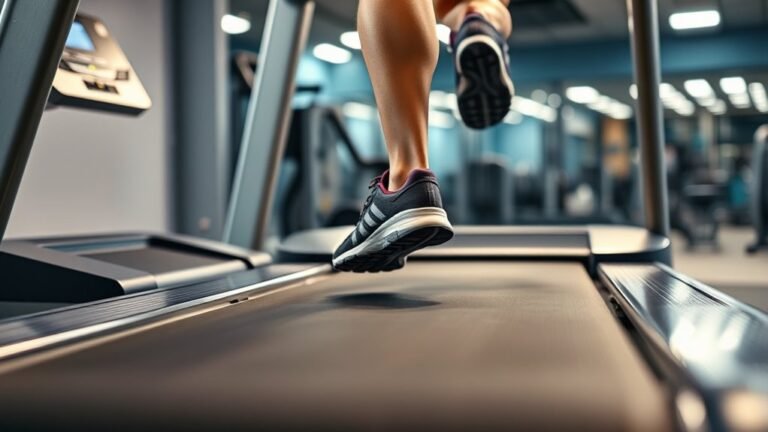
Treadmills, on the other hand, primarily target your lower body, simulating natural running or walking motions.
If you’re craving workout variety, an elliptical allows you to switch between forward and backward pedaling, changing muscle focus and intensity.
Treadmills can vary speed and incline, challenging endurance and strength differently.
Understanding these key differences helps you tailor your routine to your fitness goals, keeping your workouts fresh and effective.
Which Is Gentler on Your Joints: Elliptical or Treadmill?
Both ellipticals and treadmills offer solid cardio workouts, but how they impact your joints can differ markedly.
If joint impact is a concern, ellipticals generally provide a gentler experience. Their smooth, gliding motion reduces stress on your knees, hips, and ankles, making them ideal for injury prevention and those recovering from joint issues.
Treadmills, while effective, involve repetitive foot strikes that can increase joint stress, especially on harder surfaces or at higher speeds.
However, if you prefer running or walking, you can reduce joint impact on a treadmill by using shock-absorbing features and proper footwear.
Ultimately, choosing an elliptical can help you protect your joints while staying active, especially if injury prevention is your priority.
Both machines offer benefits, but ellipticals take the lead in joint-friendly workouts.
Choosing Cardio Based on Your Fitness Goals
Many factors come into play when choosing cardio equipment, and your fitness goals should guide your decision. If you want to improve endurance, the treadmill’s steady pace can help you build stamina effectively.
For low-impact workouts that protect your joints, the elliptical offers a smooth motion that’s easier on your body. Incorporating cardio variety can keep your routine fresh and prevent plateaus.
Consider mixing treadmill sessions with elliptical workouts to target different muscle groups and maintain motivation. Your fitness preferences matter, too—choose the equipment you enjoy using, so you stay consistent.
Ultimately, aligning your cardio choice with what you want to achieve and what you like guarantees you stick with your plan and see real progress over time.
Calorie Burn and Intensity: Elliptical vs. Treadmill
How effectively you burn calories depends largely on the intensity and type of cardio you choose.
When comparing the elliptical and treadmill, the calorie comparison shows both can deliver solid results, but your workout intensity plays a key role.
On a treadmill, running or walking at a brisk pace typically burns more calories per minute due to greater impact and muscle engagement.
However, the elliptical offers a low-impact option that still challenges your whole body, especially if you increase resistance and speed.
The elliptical provides a low-impact, full-body workout that intensifies with increased resistance and speed.
To maximize calorie burn on either machine, focus on increasing your workout intensity through intervals or incline adjustments.
By pushing yourself, you’ll turn your session into a more efficient fat-burning experience.
When to Pick Elliptical or Treadmill for Your Goals
When should you choose the elliptical over the treadmill to meet your fitness goals? It depends on your exercise preferences and workout environment. If you want low-impact cardio that’s gentle on your joints, the elliptical is ideal. Prefer running or walking with natural stride? The treadmill fits better. Your workout setting also matters. Ellipticals often suit smaller spaces and quieter areas.
| Goal | Elliptical Advantage | Treadmill Advantage |
|---|---|---|
| Joint-friendly cardio | Low-impact, less stress | Higher impact, more intensity |
| Weight loss | Steady burn with less strain | Intense calorie burn |
| Endurance training | Smooth, consistent movement | Realistic running experience |
| Workout environment | Compact, quieter option | Requires more space, noise |
Match your choice to what motivates you and your space for best results.
Frequently Asked Questions
Can Ellipticals Help Improve Balance and Coordination?
Yes, ellipticals help improve your balance and coordination by providing effective balance training and coordination exercises. You’ll engage multiple muscle groups, enhancing stability and control while enjoying a low-impact, practical workout.
Keep pushing!
What Maintenance Is Required for Elliptical Machines?
You should lubricate the belt every 100 hours and clean the console weekly; studies show well-maintained ellipticals last 30% longer. Staying consistent keeps your machine smooth, motivating you to reach your fitness goals effortlessly.
Are Treadmills Suitable for Outdoor Running Practice?
Treadmills aren’t ideal for outdoor terrain, but they help you perfect your running technique in controlled conditions. Use them to build endurance, then shift outside to adapt to varied surfaces and improve real-world performance.
Do Ellipticals Offer Upper Body Workout Options?
While treadmills focus on legs, ellipticals engage your upper body too, offering balanced workout benefits. You’ll strengthen arms and core alongside legs, making your exercise more efficient and extensive, boosting overall fitness with every stride you take.
How Do Treadmill Incline Settings Affect Workout Variety?
Treadmill incline settings boost your workout variety by simulating hills, increasing intensity, and engaging different muscles. You’ll enjoy treadmill benefits like improved endurance and calorie burn, making your sessions more challenging and effective.
Conclusion
So, which is better for you—the elliptical or the treadmill? It really depends on what you want to achieve and how your body feels.
If joint care and low impact matter most, the elliptical might be your go-to. But if you’re chasing intensity and calorie burn, the treadmill could push you harder.
Ready to make the choice that fits your goals? Your perfect workout is waiting—just one step away. When deciding between elliptical vs treadmill, consider your fitness needs to find the best fit for you.